


How period jewellery reveals its age through design, materials and craftsmanship
Few jewellery styles are imitated as often as Art Deco.
Geometric brooches, black-and-white rings, marcasite bracelets, long earrings and stepped pendants are still being produced today in forms that closely resemble pieces made a century ago.
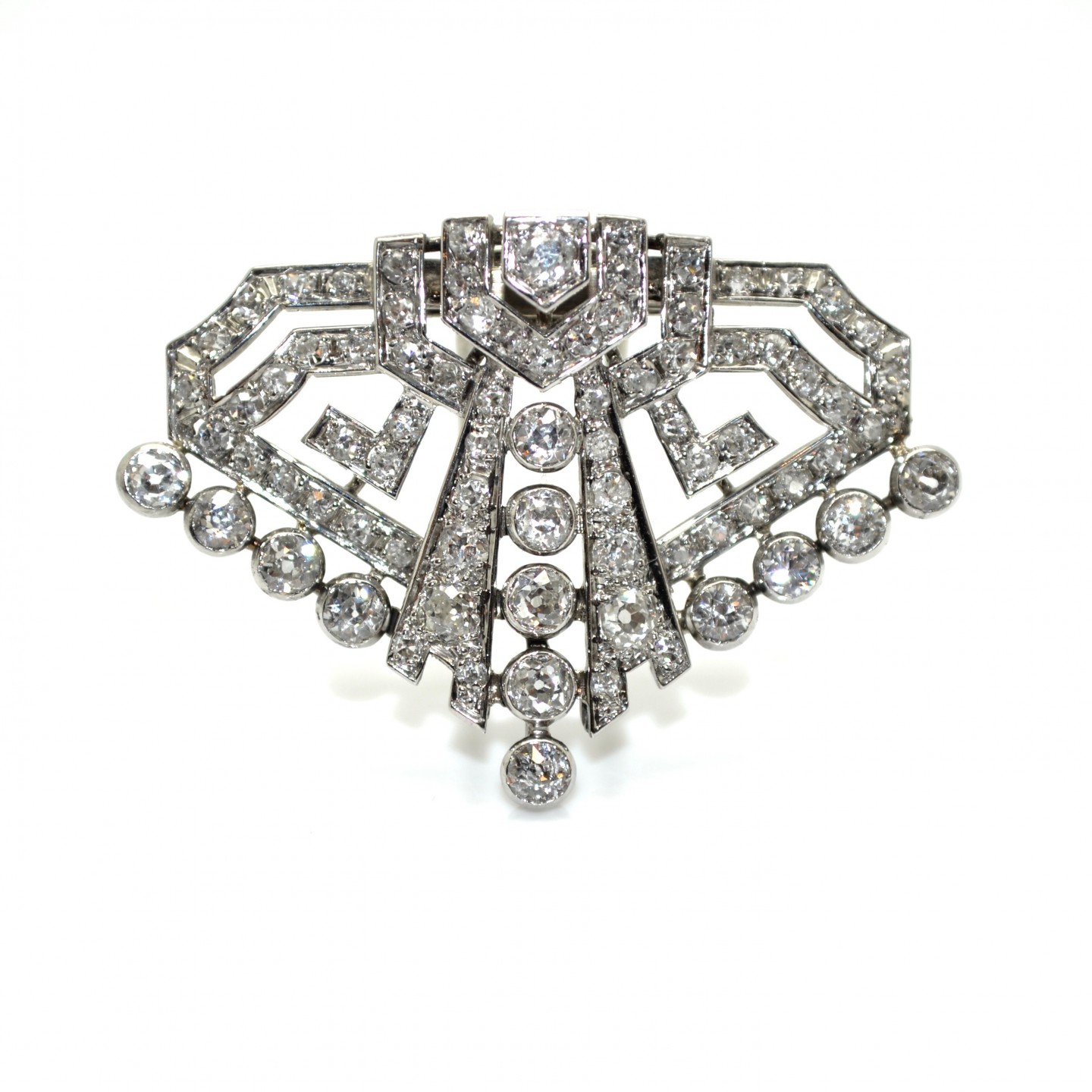
That creates an important distinction:
A jewel can be Art Deco in style without being Art Deco in date.
To describe a piece as genuinely dating from the 1920s or 1930s, its appearance is only the beginning. Materials, construction, stone cutting, hallmarks, fittings and documented context all matter.
The question is therefore not simply whether a jewel looks Art Deco.
It is whether the object itself is consistent with the period.
[[product:1]]
What was Art Deco jewellery?
Art Deco jewellery developed during the years surrounding the First World War and reached international prominence during the 1925 Exposition Internationale des Arts Décoratifs et Industriels Modernes in Paris.

The movement rejected much of the flowing naturalism associated with Art Nouveau in favour of sharper lines, symmetry, geometry and a fascination with modernity.
The Metropolitan Museum of Art describes jewellery of the 1920s as embracing sharp geometric patterns associated with the machine age, while GIA identifies strong geometry, symmetry and dramatic colour contrasts as defining features of Art Deco jewellery.
But the period was never limited to a single visual formula.
Egyptian motifs, Asian influences, stylised flowers, architectural forms, zigzags, stepped shapes and abstract geometry all appeared within the same broad movement. Sotheby’s notes the influence of Cubism, archaeology and non-European decorative traditions alongside the modern machine aesthetic. Sothebys.com

Art Deco was diverse.
That diversity is one reason why shape alone cannot date a jewel.
Style is not proof of age
This is perhaps the most important point.
Art Deco revival jewellery has been produced repeatedly from the mid-twentieth century to the present day.
A symmetrical brooch set with black and clear stones may look entirely convincing at first glance. A marcasite bracelet may reproduce the geometry of a 1930s piece almost exactly.
But visual vocabulary can be copied.
What cannot be copied quite so easily is the entire historical construction of the object.
Art Deco describes a style. Period Art Deco describes a date.
Dating requires more than aesthetic resemblance.
[[collection:1]]
Platinum, gold, silver - there was no single Art Deco metal
At the highest level of jewellery production, platinum became one of the defining materials of the period.
Its strength allowed jewellers to create delicate settings using relatively little visible metal, giving diamonds and coloured stones greater prominence. Both the V&A and Sotheby’s highlight the importance of platinum in late-1920s Art Deco jewellery, particularly in icy combinations of diamonds, rock crystal and geometric stone cuts. Victoria and Albert Museum

But period Art Deco jewellery was not exclusively platinum.
Gold remained important, particularly as tastes shifted during the 1930s. The V&A notes that gold returned strongly to fashion from around 1933, partly because it was less expensive than platinum. Victoria and Albert Museum
Silver also appears in period jewellery and jewellery designs.
This matters because an Art Deco jewel does not need to be exceptionally precious to be authentic.
Fine jewellery and more modest jewellery existed simultaneously.
Diamonds, onyx and the power of contrast
The black-and-white palette is one of the most recognisable signatures of the period.
Diamonds paired with black onyx created a severe graphic contrast perfectly suited to geometric design. Rock crystal could produce similar effects while amplifying light.
GIA describes white diamond and platinum combinations, black onyx contrasts and strong colours using emerald, ruby and sapphire as central elements of Art Deco jewellery. gia
Christie’s documents numerous period examples combining platinum, diamonds and onyx, including jewellery made around 1925. Christie's

But again, the material combination is not a date stamp.
Black glass and clear rhinestones can imitate the same look.
[[product:2]]
Art Deco was not only fine jewellery
Art Deco jewellery was never limited to diamonds, platinum and the great Parisian jewellery houses.

The 1920s and 1930s also saw the growing importance of costume jewellery: pieces designed primarily for their visual effect rather than the intrinsic value of their materials.
Glass stones, imitation pearls, silver, plated metals and new synthetic materials allowed the geometric language of Art Deco to reach a much wider audience.
Costume jewellery was not simply an inexpensive copy of fine jewellery. It became a field of design in its own right.
GIA notes the importance of costume jewellery to the period and credits Coco Chanel with helping make it fashionable and socially acceptable to wear imitation jewellery alongside clothing and precious pieces. The same period saw innovations in imitation pearls and plastics adapted specifically to jewellery.
This broader production is important when dating an object.
A genuine 1930s jewel does not need to contain diamonds, gold or platinum to belong to the Art Deco period.
Its historical interest may instead lie in its design, construction and the modern materials from which it was made.
Period does not necessarily mean precious.
Bakelite, Catalin and the new language of plastic
Few materials express the modernity of the early twentieth century as clearly as plastic.
Bakelite, developed in 1907, was the first fully synthetic phenolic plastic. Initially particularly important to the electrical industry, phenolic plastics soon entered a much wider range of consumer objects. The Metropolitan Museum notes that Bakelite became commonly used during the 1920s for objects including handbags and jewellery. Cooper Hewitt Smithsonian Design Museum

For Art Deco designers, these materials offered something radically different from traditional jewellery materials.
They could be moulded, carved and produced in strong colours, allowing jewellery to become bold, graphic and sculptural without relying on precious stones.
By the 1930s, plastic was no longer necessarily regarded merely as an imitation of ivory, tortoiseshell or other expensive natural materials. Cooper Hewitt notes that it increasingly came to be appreciated for its own colour, versatility and affordability, becoming particularly important to the flourishing costume jewellery industry. Cooper Hewitt Smithsonian Design Museum
Bracelets, brooches, dress clips and other accessories could therefore embrace the scale and geometry of modern design in entirely new ways.
[[collection:3]]
Bakelite is not the whole story
The word Bakelite is now frequently used as a broad label for vintage phenolic jewellery, but the material history is more complicated.
Bakelite was followed by other phenolic plastics, including Catalin, which could be produced in a much wider range of vivid and translucent colours and was specifically used for jewellery and decorative objects. Cooper Hewitt distinguishes Catalin as one of the colourful phenolic plastics that followed Bakelite and notes its use in jewellery. Cooper Hewitt Smithsonian Design Museum
Other early plastics and semi-synthetic materials also appeared in jewellery, including celluloid and casein-based plastics, each with different visual and physical characteristics. Cooper Hewitt Smithsonian Design Museum
For this reason, describing every early plastic jewel simply as “Bakelite” can be misleading.
Just as Art Deco style does not establish a date, a familiar material name should not replace proper material identification.
Not every vintage plastic jewel is Bakelite — and Bakelite alone does not make a jewel Art Deco.
Stone cuts can help establish context
Gem cutting changed significantly during the late nineteenth and early twentieth centuries.
Old European-cut diamonds remained common into the early decades of the twentieth century and are frequently encountered in Art Deco jewellery. GIA describes them as having smaller tables, higher crowns and visible culets compared with modern round brilliant diamonds. GIA 4Cs
At the same time, Art Deco designers enthusiastically embraced geometric cuts.
Baguettes, emerald cuts, triangles and other angular shapes could be arranged almost architecturally, creating the mosaic-like compositions associated with the period. Sotheby’s identifies these cuts as important elements of Art Deco jewellery design. Sothebys.com
Stone cutting can therefore support a dating assessment.
But an old-cut stone may have been reset later, and a modern stone can be placed into an antique-style mounting.
Nothing should be read in isolation.
The construction can tell a different story from the front
One of the most interesting aspects of jewellery study is that the reverse can be as informative as the front.
Period pieces may show carefully pierced galleries, hand-finished settings, articulated links and mechanical systems designed specifically for the jewel.
GIA documents Art Deco brooches with saw-pierced construction and millegrain work, while Christie's notes examples whose reverse surfaces received the same attention to detail as their fronts. GIA 4Cs

This does not mean that every antique jewel must appear handmade or irregular.
Jewellery production was already sophisticated and increasingly industrialised.
What matters is whether the construction, fittings and finishing make sense together.
Clasps and fittings can help — but they do not date a jewel on their own
Clasps, hinges and pin mechanisms can provide useful chronological clues, particularly on brooches.
The trombone clasp, for example, is strongly associated with European jewellery from the late nineteenth century into the first half of the twentieth century. Specialist jewellery references describe it as a sliding tubular fastening commonly found on brooches of the period, including examples from the 1920s. blog.acsilver.co.uk

Likewise, simple C-shaped catches, tube hinges and later locking or rollover safety catches can contribute to an assessment of age. But these mechanisms were often used across long periods, and some continued in production long after newer systems had appeared. My Vintage
Most importantly, jewellery is frequently altered during its lifetime. A broken pin may be replaced, an earring converted, or a clasp modernised decades after the original jewel was made.
For that reason:
A clasp can support a date. It should never establish the date by itself.
The fastening should be considered together with the hinge, soldering, metal, stone settings, construction and the overall design of the jewel. This “whole object” approach is also recommended by specialist guides to dating vintage jewellery. VINTAGE & ANTIQUE JEWELRY BUYER
[[product:1]]
Hallmarks must be interpreted carefully
Hallmarks and fineness marks can be extremely useful.
They may identify a precious-metal standard, country, maker or assay system.
But a number alone rarely gives a precise production date.
Marks such as 800 or 835, for example, can indicate silver fineness in continental European systems. German silver regulations historically used decimal fineness marks alongside national and maker’s marks, but these standards continued across long periods of production. 925-1000
So:
A silver fineness mark is evidence of metal content — not automatically evidence of the 1920s or 1930s.
The same principle applies more broadly.
A hallmark becomes much more meaningful when it can be connected with a known maker, national system or documented period of use.
The absence of a hallmark does not settle the question
Not every period jewel survives with perfectly readable marks.
Marks may be extremely small, worn, hidden beneath fittings or lost during repair.
Lower-cost jewellery may also provide less documentary evidence than signed haute joaillerie.
This means that an unsigned piece should not automatically be rejected.
But the absence of marks increases the importance of the other evidence.
Construction, materials, proportions, stone setting and documented comparisons must do more of the work.
Authentic Art Deco is not always perfectly geometric
Modern revival pieces sometimes exaggerate what we think Art Deco should look like.
Not every period jewel consists of black onyx, diamonds and perfect zigzags.
GIA notes that earlier Art Deco pieces could be softer and more decorative, while the later phase became increasingly austere and geometric. gia
Cartier’s colourful carved-stone jewellery, exotic influences and floral compositions existed alongside severe monochrome geometry.
So a piece should never be rejected simply because it does not fit the most stereotypical image of the style.
Historical movements are almost always more varied than their modern reproductions.
[[product:2]]
Art Deco revival: when the style outlives the period
Art Deco became influential enough that its language never truly disappeared.
Later manufacturers repeatedly returned to the same symmetry, stepped geometry, black-and-white contrast and machine-age elegance.
Some revival jewellery is itself vintage today.
That makes terminology especially important.
A 1980s Art Deco revival brooch may be genuinely vintage and beautifully made.
It is simply not a 1920s Art Deco brooch.

Those are two different descriptions, and both can be valid.
[[product:4]]
A piece from Les Trois Curieuses
Our Art Deco Geometric Brooch illustrates why separating style from dating matters.
Its strong symmetry, openwork construction and contrasting black and clear stones belong unmistakably to the visual vocabulary associated with Art Deco.
Those characteristics describe its design language.
They should not, by themselves, be treated as proof of a particular production year.
The piece can instead be examined through several layers of evidence: construction, metal, stones, fittings, marks and comparison with documented examples.
That distinction — between what an object resembles and what the object allows us to demonstrate — is central to our approach.
[Discover the Art Deco Geometric Brooch →](/products/vintage-art-deco-brooch-black-clear-rhinestone-geometric-pin-1920s-1930s-style-antique-silver-tone-statement-jewelry)
Dating jewellery means building an argument
There is rarely one magical detail that proves a jewel was made in 1927 rather than 1977.
Instead, dating is usually cumulative.
The style may fit.
The metal may fit.
The hallmark may fit.
The stone cuts may fit.
The construction may fit.
The fittings may fit.
When these elements agree, the attribution becomes stronger.
When they contradict one another, caution becomes necessary.
And that is ultimately the distinction between recognising a style and studying an object.
A geometric design is not a date.
A hallmark is not a complete history.
And “Art Deco style” does not automatically mean “Art Deco period.”
For antique jewellery, the most convincing attribution is the one in which the evidence tells the same story.


