


From Art Deco and Bauhaus-inspired motifs to everyday design in the GDR
A serving tray is one of the most ordinary objects in the home.
It carries coffee, glasses, breakfast or a bottle from one room to another. It is useful, inexpensive and rarely treated as an important object of design.
And yet, for much of the twentieth century, a small factory in the Thuringian town of Wasungen turned this ordinary household object into an extraordinary catalogue of graphic design.
The company was Rudolph & Franz, later known as RuFra.
Between the early twentieth century and 1989, RuFra produced serving trays combining simple wooden frames, glass surfaces and printed or painted decoration. Their imagery moved with the century itself: floral ornament, Japonism, Art Deco, geometric abstraction, Bauhaus-influenced compositions and eventually the bold graphic language associated with post-war East German interiors. MFI Berlin
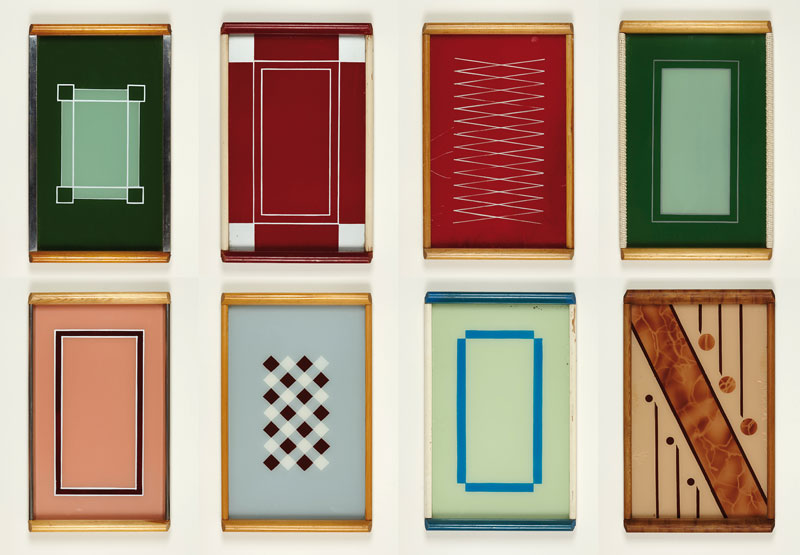
Today, hundreds of these trays survive.
Many were once inexpensive household objects.
Together, they form something much more interesting:
a visual archive of changing popular taste.
[[product:1]]
Who was RuFra?
RuFra was the shortened name of Wasunger Rohrmöbel- und Korbwaren-Fabrik Rudolph & Franz, based in Wasungen in southern Thuringia.
The DDR Museum in Berlin identifies surviving trays directly with the company under its full name, while research associated with exhibitions on the trays records production in Wasungen from 1912 until 1989. DDR Museum
The company's full title is revealing.
It was originally associated with furniture and wicker goods, not simply serving trays.
Over time, however, the small decorated tray became one of the products most strongly associated with the RuFra name. When the Stadtmuseum Wasungen began researching the company's history for an exhibition in 2017, local reporting described the former business as particularly well known for its serving trays. inSüdthüringen

That long production period is essential.
RuFra was not originally an East German company.
It existed before the Second World War, then continued operating after Wasungen became part of the German Democratic Republic.
So although many surviving RuFra trays are correctly described as DDR design, the history of the object itself begins much earlier.
One construction, hundreds of identities
The basic RuFra tray was remarkably simple.
According to research presented by Berlin's Ministerium für Illustration, the trays generally consist of:
a wooden surrounding frame,
a fibreboard base,
and a sheet of glass carrying or protecting the decorative motif. MFI Berlin
The structure changed relatively little.
The image changed constantly.
And that is where the real design history lies.
The same inexpensive domestic format could be adapted to almost any decorative fashion.
One decade might favour flowers.
Another might favour disciplined geometry.
Another might introduce coloured grids, abstract circles or hard-edged compositions.
Rather than reinventing the physical object, RuFra repeatedly reinvented its surface.
A surprisingly broad design vocabulary
Research into surviving Wasungen trays has identified a remarkable range of influences.
The motifs include nature, Jugendstil, Art Deco, Japonism, ornament, Bauhaus-related geometry, abstraction and Concrete Art. MFI Berlin

[[product:2]]
That list alone complicates the way these pieces are often described online.
A geometric RuFra tray is sometimes casually called “Bauhaus.”
Another might be sold as “Art Deco.”
Another as “mid-century.”
Those terms may describe aspects of the visual language.
But RuFra production lasted for decades, and the factory repeatedly borrowed from or responded to changing decorative trends.
A Bauhaus-looking pattern does not automatically mean a Bauhaus-period object.
Style and date must still be separated.
Exactly the same lesson that applies to jewellery or ceramics applies here.
How were the patterns made?
This is one of the most interesting parts of RuFra production.
The decoration was not always simply a printed sheet sitting beneath glass.
According to the 2016 research exhibition on Wasungen trays, earlier examples could be decorated using stencils or freehand painting, while other motifs were screen-printed directly onto the glass and then covered with a continuous layer of paint. MFI Berlin
This continued through much of the twentieth century.
Only in the 1980s did the production method shift toward placing pre-printed paper sheets beneath the glass. MFI Berlin
That distinction can matter enormously when examining an individual tray.
What looks from above like an ordinary printed geometric image may in fact be decoration applied directly to the reverse of the glass.

The glass therefore does two jobs:
it creates the usable surface,
and it protects the image underneath.
Why reverse decoration works so well
Putting decoration beneath or behind glass gives these objects a particular visual character.
The glass adds depth.
Colours appear slightly more saturated.
The design is protected from direct contact with cups and dishes.
And because the decorative layer is physically separated from the viewer by the glass surface, even relatively simple shapes can acquire a polished, almost enamel-like quality.
It is a clever solution for an inexpensive domestic product.
The user gets a smooth, washable surface.
The manufacturer gets a large graphic field.
And the decoration remains central to the object's identity.
[[collection:1]]
Design for ordinary life
One reason RuFra is interesting is precisely because these trays were not luxury design.
A red, white and silver RuFra tray preserved by the DDR Museum carried an official retail price — EVP — of just 2 East German marks. DDR Museum
That detail changes how we should look at them.
These were not museum pieces created for a tiny design elite.
They belonged to daily life.
They sat in kitchens and living rooms.
They carried drinks.
They accumulated scratches.
They were inexpensive enough to be ordinary.
And yet a modest industrial object could still carry a remarkably ambitious graphic composition.
This is one of the fascinating aspects of twentieth-century product design:
good visual design does not require an expensive object.
RuFra and the GDR
After the creation of the German Democratic Republic in 1949, the RuFra trays became part of the material culture of East German domestic life.
The DDR Museum now preserves examples in its collection, including wooden trays with coloured glass decoration explicitly attributed to RuFra-Wasungen. DDR Museum
The surviving designs from this period often feel strikingly modern.
Geometric divisions, overlapping circles, sharp colour contrasts and abstract motifs reflect a broader international language of post-war graphics.
But calling every geometric RuFra tray “Bauhaus” oversimplifies that history.
The Bauhaus had closed in 1933.
A tray manufactured in the 1960s could certainly inherit ideas associated with modernist geometry, but that does not make it a Bauhaus product.
A better description may be:
post-war East German geometric design,
modernist graphic design,
or simply RuFra Wasungen, c. 1950s–1960s, where evidence supports the date.
Not every Wasungen tray looks “East German”
This long chronology produces another interesting problem.
The company manufactured trays across very different political and cultural periods.
Pre-war objects can reflect Art Deco or earlier decorative languages.

Post-war examples can adopt mid-century abstraction.
Later pieces can look unmistakably 1970s or 1980s.
The manufacturer remained.
The visual culture around it changed.
That makes RuFra unusually useful for studying how a single household product absorbed successive generations of taste. MFI Berlin
Custom designs existed too
RuFra did not limit itself entirely to standard catalogue motifs.
Research on the company's production indicates that it was also possible to commission special motifs for anniversaries and similar occasions. MFI Berlin
This is important when trying to catalogue surviving examples.
An unfamiliar motif does not necessarily mean the tray is unrelated to RuFra.
Some designs may have been produced in smaller quantities for particular organisations, celebrations or clients.
It also explains why the variety of surviving trays can feel almost endless.
The marks matter
Some RuFra trays survive with manufacturer stamps or labels.

Others do not.
The DDR Museum's firmly documented examples are useful because they establish known combinations of construction and manufacture. DDR Museum
But visual similarity alone should still be treated carefully.
Wooden frames with decorated glass inserts were not unique to RuFra.
So:
A Wasungen-style tray is not automatically a RuFra tray.
A surviving RuFra mark is the strongest evidence.
In its absence, construction, age, decoration and comparison with documented pieces can support an attribution — but the language should reflect the level of certainty.
Again, an attractive attribution is not necessarily a documented one.
[[collection:3]]
From forgotten household object to design collection
For decades, these trays occupied an awkward position.
Too common to be considered important antiques.
Too utilitarian to attract the same attention as furniture or lighting.
And often too inexpensive for detailed scholarship.
That has started to change.
In 2016, designers and collectors Bernard Stein, Anky Brandt and Markus Etienne presented an exhibition in Berlin devoted to the Wasungen trays and their graphic history. MFI Berlin
The Stadtmuseum Wasungen subsequently researched Rudolph & Franz and prepared its own exhibition around the company's history. inSüdthüringen
And more recently, the Kitchen Culture exhibition at Munich's Pinakothek der Moderne included a wall installation of around 300 original GDR serving trays, drawn from the Ludmila and Rolf Podlasly collection. The published exhibition material identifies the Wasungen factory directly. Berührungspunkte

An object that once cost only a few marks has become evidence of twentieth-century design culture.
Two RuFra pieces from Les Trois Curieuses
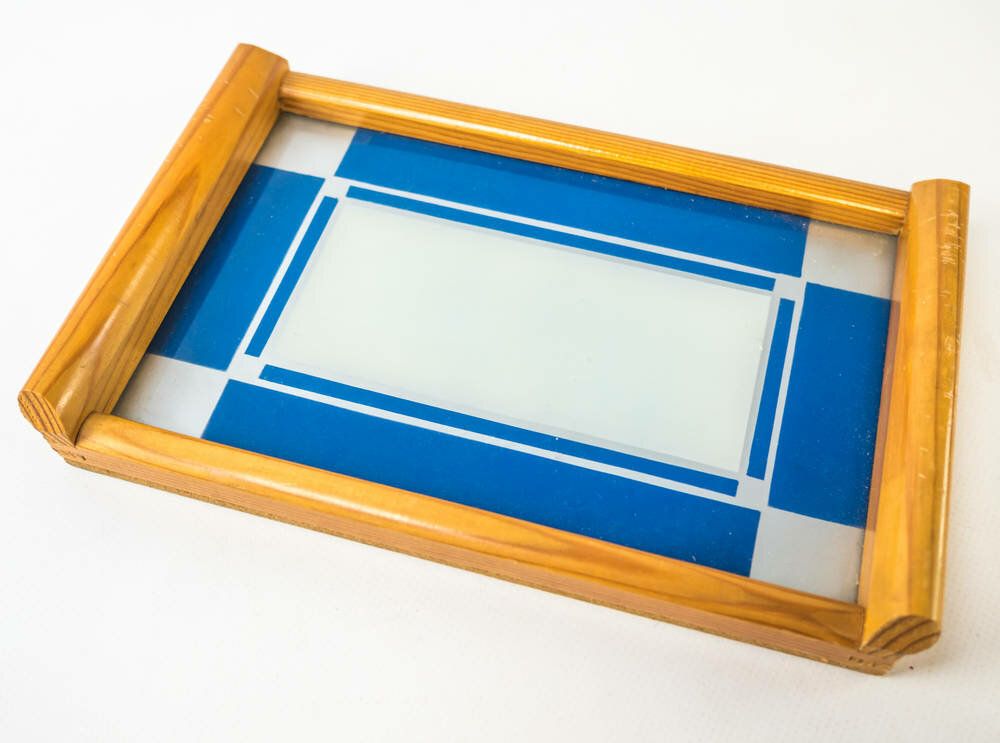
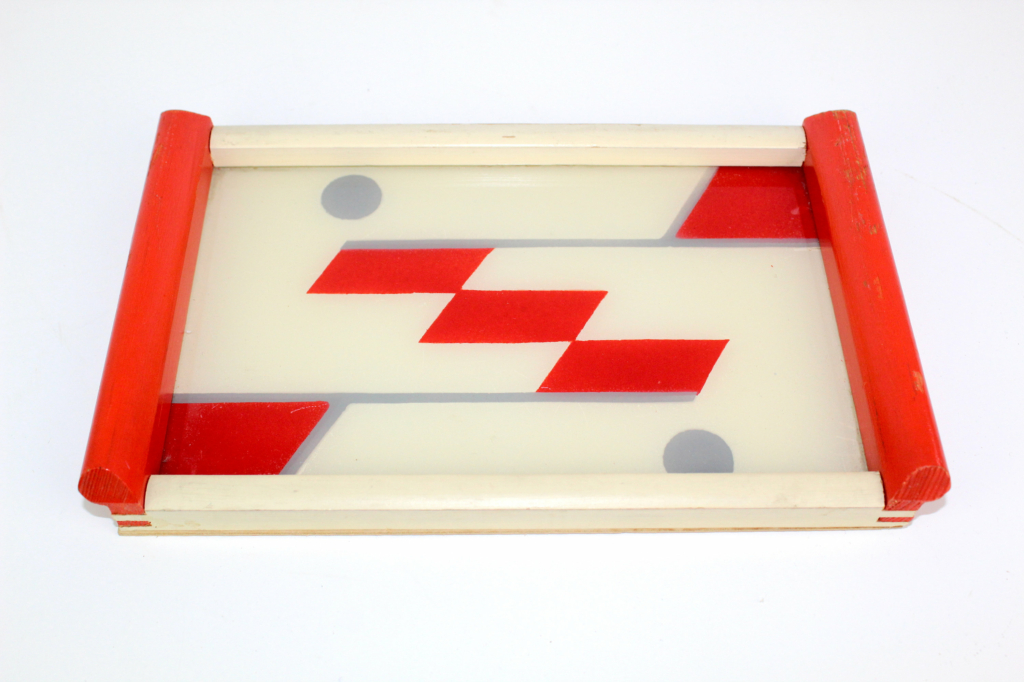
Our two RuFra Wasungen trays show how much variation could exist within the same apparently simple format.
Both use the characteristic relationship between wood, glass and graphic decoration, but their patterns create distinctly different visual identities.
One has the proportions of a larger serving tray; the other is a more compact cocktail format.
Seen individually, each is an attractive mid-century household object.
Seen within the history of RuFra, they become part of a much larger story: a factory using one basic domestic form as a surface for constantly changing graphic design.
[[product:1]]
[[product:2]]
Why these little trays matter
Design history often concentrates on famous designers and expensive objects.
RuFra suggests another way of looking at it.
No celebrity designer is required.
No precious material is required.
No limited edition is required.
Instead, the interest lies in how a familiar household object changed alongside society.
Over decades, the same basic tray absorbed Art Deco, modernism, abstraction and the visual culture of the GDR.
Its price remained modest.
Its function remained simple.
But its surface became a record of changing taste.
And perhaps that is why hundreds of them together are so much more powerful than one alone.
RuFra did not reinvent the serving tray. It repeatedly reinvented what a serving tray could look like.


