


From ox horn to Plexiglas, colour and the modern Italian home
Today, the name Guzzini immediately evokes transparent acrylic, saturated colour and the optimistic domestic design of the 1960s and 1970s.
Ice buckets, trays, tableware, stacking glasses and sculptural serving pieces appear on the vintage market in materials that seem inseparable from the Space Age.
But Guzzini's story did not begin with plastic.
It began with ox horn.
And the transition from a traditional natural material to Plexiglas and injection-moulded plastic tells a much larger story about the transformation of Italian manufacturing during the twentieth century.
[[product:1]]
From ox horn to modern industry
The company was founded in Recanati, in the Marche region of Italy, in 1912 by Enrico Guzzini.
Its earliest production consisted of small domestic objects made from ox horn, a traditional material that could be heated, shaped and polished.
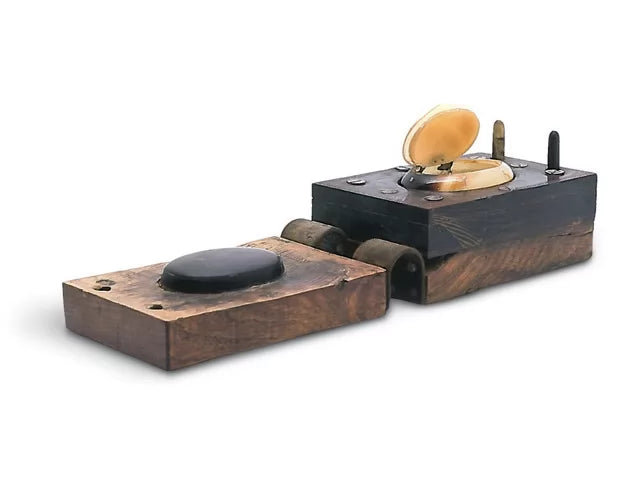
Italian state archival records trace the business from Enrico Guzzini's original individual company through PM Guzzini and PMS Guzzini before the later Fratelli Guzzini organisation emerged. SIUSA
This origin is important because plastic did not simply appear from nowhere in Guzzini's history.
The company was already accustomed to working with a material that could be softened and shaped.
When new synthetic materials became available, the manufacturing logic could evolve with them.
1938: Plexiglas enters the home
The decisive moment came in 1938.
According to both Guzzini's own historical timeline and the Italian archival record, the company began introducing Plexiglas — acrylic glass — into household objects at a time when domestic manufacturing remained heavily tied to traditional materials. Guzzini Online Shop
That shift was radical.
Plastic was still a relatively novel material. It did not yet carry the disposable associations it would acquire much later in the twentieth century.
Instead, materials such as polymethyl methacrylate — commonly known through trade names including Plexiglas — offered designers something extraordinary:
transparency without glass,
colour without paint,
and forms that could increasingly be produced industrially.
For Guzzini, plastic was not initially a cheap substitute.
It became a design material in its own right.
The 1950s: colour inside the material
Guzzini continued experimenting with acrylic after the war.
The company's own history records the development of coloured methacrylate and two-colour acrylic production through thermoforming during the 1950s. By 1955, it identifies itself as introducing designed plastic objects specifically for domestic use. Guzzini Online Shop
This distinction matters.
Colour did not necessarily have to be painted onto an object.
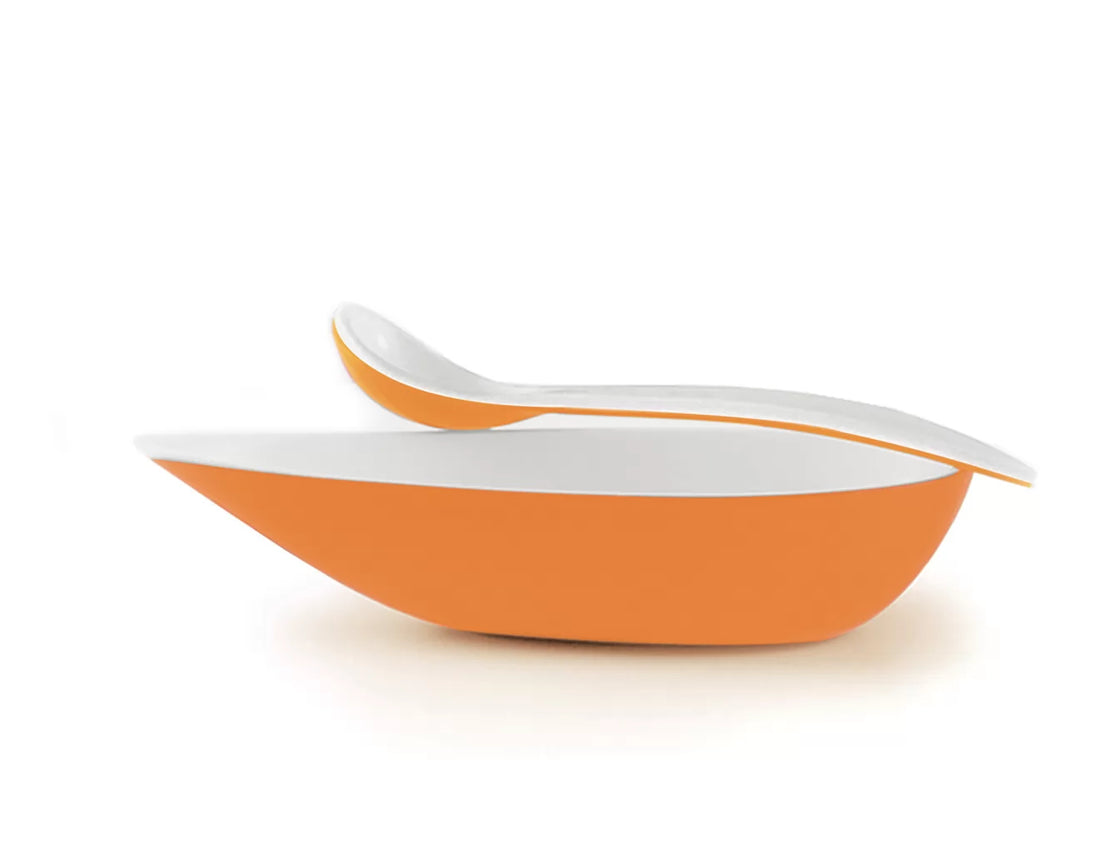
It could exist within the material itself.
Transparent amber, smoke, red, orange and clear acrylic could be layered visually with chrome, black plastic or contrasting coloured elements.
That combination would later become one of the most recognisable languages of post-war Italian interiors.
The 1960s: plastic becomes design
The early 1960s brought another technological change: injection moulding of coloured plastics for household production.
Italian archival records identify this period as the moment when Guzzini moved increasingly towards large-scale industrial production of everyday objects with a strong design component. SIUSA
And the company began working closely with designers.
One of the most important was Luigi Massoni.

The Italian state archive specifically identifies Massoni among the figures brought into Guzzini's developing design culture during this period. SIUSA
The relationship produced objects that were not simply practical plastic utensils.
They were conceived as industrial design.
Luigi Massoni and Guzzini
Massoni's work shows how dramatically plastic changed domestic objects.
In 1967, he designed a set of acrylic stacking tumblers for Fratelli Guzzini.
They are now part of the Museum of Modern Art's Architecture and Design collection in New York. The Museum of Modern Art
The idea is deceptively simple.
Glasses that stack neatly save space.
But the shape required to make them stack also becomes their aesthetic identity.
Function and appearance are therefore inseparable.
That principle appears again and again in good industrial design of the period: an object looks distinctive because of the way it works, rather than because decoration has been added afterwards.
Plastic was not pretending to be something else
This is one of the biggest changes between early synthetic materials and the plastic culture of the 1960s.
Early plastics were frequently used to imitate natural materials.
They might resemble ivory, tortoiseshell, horn or amber.
But by the post-war period, designers increasingly celebrated plastic as plastic.
Transparency became exaggerated.
Colours became brighter.
Forms became thicker, smoother and more obviously moulded.
Instead of disguising the material, designers exploited what traditional materials could not do as easily.
Guzzini's production belongs directly to this moment.
The most interesting plastic design does not imitate another material. It uses plastic to do what only plastic can do.
The Italian table becomes a complete design system
During the 1970s, Guzzini moved towards coordinated table systems in which colour and form could run across multiple objects.
The company's historical timeline specifically identifies this decade with the development of its first complete coordinated tableware systems. Guzzini Online Shop
This was a particularly modern idea.
A tray, bowl, pitcher, ice bucket and serving object no longer had to be unrelated utensils accumulated over time.
They could form a visual system.
That approach fitted perfectly into the wider transformation of Italian domestic interiors, where product design, furniture, lighting and graphics increasingly became parts of the same cultural language.
Guzzini at MoMA
Guzzini's place in the international history of Italian design was already visible by the early 1970s.
In 1972, the Museum of Modern Art staged its landmark exhibition Italy: The New Domestic Landscape, examining the extraordinary experimentation taking place in Italian design.
Among the objects included was the Bombo ice bucket, designed by Studio TG for Guzzini in 1970, made from transparent acrylic. The Museum of Modern Art
That appearance matters.
Guzzini was no longer simply a manufacturer of practical household goods.
Its products had entered the international conversation around modern Italian design.
[[product:2]]
Fratelli Guzzini and Harvey Guzzini are not exactly the same thing
This is where vintage listings become confusing.
Fratelli Guzzini and Harvey Guzzini share the Guzzini family history, geography and enthusiasm for new materials.
But they should not be treated as interchangeable names for the same production.
Harvey Creazioni originated as a separate enterprise in the Guzzini family orbit, established around 1958–1959 and initially producing decorative objects before increasingly specialising in lighting. Italian state archives trace its names through Harvey Creazioni, Harvey Guzzini and eventually iGuzzini Illuminazione. SIUSA
Fratelli Guzzini, meanwhile, remained strongly associated with objects for the home and table.
So a 1970s acrylic serving piece marked Fratelli Guzzini and a Harvey Guzzini lamp belong to related histories — but not to exactly the same company narrative.
And “Harvey Guzzini” was not a designer
Another common misunderstanding comes directly from the way objects are described online.
A lamp may be advertised as:
“designed by Harvey Guzzini.”
But Harvey Guzzini was a brand/company name, not the name of an individual designer.
The lighting company worked with actual designers including Luigi Massoni, Gio Ponti, Rodolfo Bonetto, Fabio Lenci, Ennio Lucini and others. The official iGuzzini history records its collaboration with Massoni beginning in 1964 and the creation of the Design House brand in 1968, whose products involved several prominent designers. iGuzzini
So:
Harvey Guzzini is a manufacturer attribution, not a designer attribution.
Exactly the sort of distinction that matters when cataloguing vintage design.
Guzzini was never one designer
The same principle applies to Fratelli Guzzini.
Objects are sometimes vaguely described as “Guzzini design” as though the company itself represented a single creative hand.
It did not.
Guzzini collaborated with numerous designers over the decades.
Luigi Massoni is particularly important to its post-war development, while designers such as Ambrogio Pozzi also worked with the company. ADI records Pozzi's collaborations with both Fratelli Guzzini and Guzzini Illuminazione among his wider work in ceramics, glass and plastics. adi-design.org
A Guzzini mark can therefore establish the manufacturer.
It does not necessarily establish the designer.
[[collection:1]]
How should vintage Guzzini be attributed?
This is particularly relevant because acrylic household objects are frequently misattributed.
Many manufacturers embraced transparent and coloured plastics during the 1960s and 1970s.
A smoky acrylic bowl, chrome carousel or orange Plexiglas tray is not automatically Guzzini simply because it looks Italian.
Likewise, an authentic Guzzini piece should not automatically be attributed to Luigi Massoni merely because he was one of the company's best-known collaborators.
A stronger attribution may come from an original label, moulded manufacturer's mark, catalogue reference, documented model or museum comparison.
Once again:
maker, designer and style are three different questions.
A piece from Les Trois Curieuses
Objects by Guzzini are particularly interesting today because their materials capture the optimism of post-war design so clearly.
In the Guzzini pieces selected by Les Trois Curieuses, transparent acrylic interacts with contrasting dark or metallic elements in exactly the way that made these materials so compelling during the period.
The effect is simultaneously functional and sculptural.
Rather than treating plastic as a lesser substitute for glass, metal or wood, these objects make the synthetic material their principal visual feature.
And that is the historical context in which they make the most sense.
[[product:1]]
From horn to acrylic
Perhaps the most surprising part of the Guzzini story is how logically its history develops.
In 1912, the company shaped natural horn.
In 1938, it adopted Plexiglas.
In the post-war decades, it explored coloured acrylic, thermoforming and injection moulding.
By 1967, a Guzzini acrylic drinking glass had entered the design vocabulary later preserved by MoMA. Guzzini Online Shop
And by the 1970s, plastic was no longer the future.
It was already part of everyday life.
Guzzini's importance lies partly in that transition.
The company did not simply make beautiful objects from plastic.
It helped demonstrate that an industrial synthetic material could become part of serious domestic design.
Guzzini's story is not really the history of plastic replacing traditional materials. It is the history of plastic becoming a design material of its own.


