


How a small town on the French Riviera became one of the great centres of twentieth-century ceramics
The word Vallauris appears constantly in vintage ceramics.
A sculptural vase. A brightly glazed pitcher. A black-and-orange ashtray. A rustic bowl. A biomorphic lamp base.
They may look completely different — yet all can be described as “Vallauris.”
That is because Vallauris is not a factory, a designer or even a single ceramic style.
It is a town.

And during the twentieth century, that town became one of the most extraordinary centres of ceramic experimentation in France.
Its history stretches far beyond the familiar image of colourful post-war pottery. Vallauris had been producing ceramics for centuries before Picasso arrived — and Picasso's presence was only one chapter in a much larger story.
Vallauris identifies a place of production. It does not identify a maker.
[[product:2]]
A pottery town long before Picasso
Vallauris, on the French Mediterranean coast near Cannes, has an exceptionally long ceramic tradition.
Archaeological evidence shows ceramic activity in the region from antiquity, but the distinctive pottery industry of Vallauris developed especially from the sixteenth century, after the town was repopulated by families arriving from Liguria. Vallauris Golfe Juan
The local clay was particularly suited to utilitarian pottery.
For centuries, Vallauris became known above all for cooking vessels — especially pignates, cooking pots, and poêlons, shallow cooking pans.
These were not primarily art objects.
They were everyday domestic tools.
During the eighteenth century, potters also developed jaspé decoration, in which slips or oxides were allowed to run, splash or marble across the surface. Vallauris Golfe Juan
By the second half of the nineteenth century, better transport by sea and railway allowed Vallauris pottery to circulate more widely. Workshops expanded and the local ceramic industry became increasingly organised and commercial. Vallauris Golfe Juan
The Massier family and the birth of artistic ceramics
The transformation from utilitarian pottery into art ceramics began before the twentieth century.

During the late nineteenth century, the Massier family played a major role in developing artistic ceramic production in Vallauris.
The municipality itself identifies the Massiers as central to the emergence of Vallauris céramique d’art, which developed alongside the town's traditional cooking pottery. Vallauris Golfe Juan
The significance of this shift is easy to underestimate.
Ceramic was no longer valued only for its practical function.
Glaze, surface, colour and sculptural form could become the principal purpose of the object.

That created the foundations upon which the post-war Vallauris phenomenon would later develop.
Decline before rebirth
The traditional pottery industry began to decline during the early twentieth century.
Metal cookware and other new domestic materials gradually replaced the earthenware cooking vessels for which Vallauris had been famous.
The decline intensified during the 1930s. Vallauris Golfe Juan
Some factories responded by diversifying.
From the 1930s onward, workshops including Foucard-Jourdan, Saltalamacchia and Milazzo developed decorative and utilitarian wares marketed as Provençal or rustic pottery — pitchers, table services and decorative objects rather than traditional cooking pots. Vallauris Golfe Juan
This transition matters because it means that the famous post-war revival did not suddenly appear from nowhere.
Vallauris already possessed generations of technical knowledge, workshops, kilns and ceramic workers.
What changed was the type of object being produced — and the artists who began arriving.
[[product:1]]
Picasso discovers Vallauris
In 1946, Pablo Picasso visited the Madoura pottery workshop in Vallauris and met its founders, Suzanne and Georges Ramié. Musées Nationaux Alpes-Maritimes
Madoura itself had been established in 1938. Musées Nationaux Alpes-Maritimes
Picasso became fascinated by ceramics.
In the spring of 1948, he moved to Vallauris, first living at the Villa La Galloise and later working from a studio in a former perfume factory at Le Fournas. Musées Nationaux Alpes-Maritimes
Ceramics became a major part of his activity there.
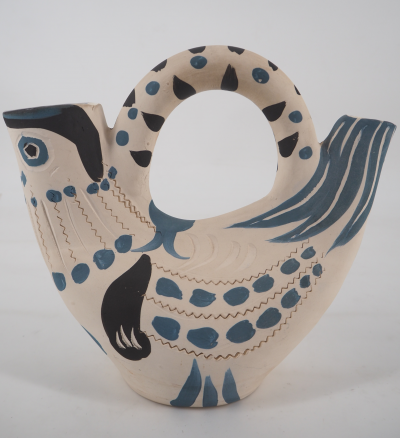
At Madoura, he worked with traditional pottery forms — plates, dishes, jugs and vases — but transformed them through painting, incision, modelling and alteration.

A vessel could become a face.
A pitcher could become an animal.
A plate could become a sculptural image.
The Musée national Picasso describes thousands of ceramic objects created by Picasso through the Madoura workshop during his Vallauris period. Musées Nationaux Alpes-Maritimes
Picasso did not invent Vallauris ceramics
This distinction is important.
Vallauris had been a pottery town for centuries before Picasso arrived.
He did not create its ceramic tradition.
What he did was bring extraordinary international visibility to it.
The municipality credits Picasso's arrival with giving the local ceramic industry new momentum and encouraging many other artists to come to Vallauris to experiment with clay and firing techniques. Vallauris Golfe Juan
So the relationship works both ways.
Vallauris gave Picasso access to ceramic expertise and working kilns.
Picasso gave Vallauris enormous cultural visibility.
Picasso did not create Vallauris pottery. He helped transform how the world looked at it.
The 1950s: the golden age
The 1950s became the celebrated golden age of Vallauris ceramics.
The town attracted trained ceramicists, painters, sculptors and designers.
The Musée Magnelli describes Vallauris during this period as an extraordinarily active centre of post-war ceramic creation. Vallauris Golfe Juan
Among the major names associated with Vallauris were:
Roger Capron, Jean Derval, Gilbert Portanier, Roger Collet and Suzanne Ramié. Vallauris Golfe Juan
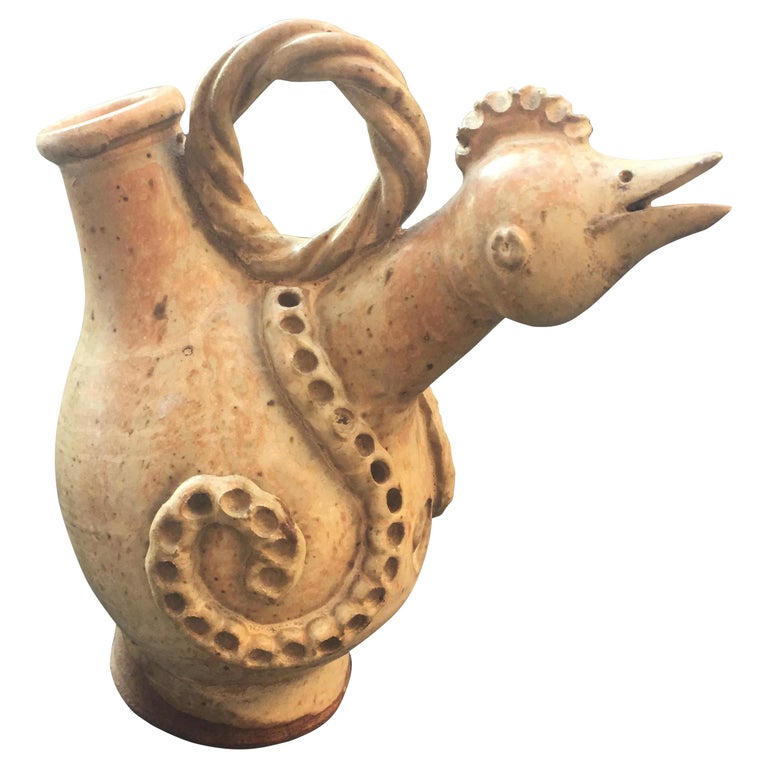
And Vallauris drew artists whose main careers were not in ceramics at all.
Henri Matisse, Marc Chagall, Jean Cocteau and Victor Brauner were among those who came to explore the possibilities of ceramic production and the arts du feu. Musées Nationaux Alpes-Maritimes
For roughly a decade, the town became something close to an open laboratory.
Artists and technicians worked alongside one another.
Traditional potters encountered modern artists.
Utilitarian forms became sculpture.
Painting moved from canvas to clay.
[[collection:4]]
There was never one “Vallauris style”
This is where modern collecting vocabulary becomes misleading.
Because the word Vallauris became so strongly associated with post-war decorative ceramics, it is sometimes treated almost like a stylistic category.
But the production was extraordinarily varied.
One workshop might produce elegant modernist stoneware.
Another might create brightly glazed figurative ceramics.
Another could specialise in rustic serving ware.
Another might explore architectural forms, textured glazes or abstract sculpture.
The official museum collection itself is organised around precisely this diversity: traditional utilitarian pottery, the Massier family's artistic ceramics, the explosion of creativity in the 1950s and the many artists who passed through the town's workshops. Vallauris Golfe Juan
So:
There is no single Vallauris look.
A piece does not become Vallauris merely because it has a thick glaze, an irregular shape or orange-and-brown decoration.

[[product:2]]
“Vallauris” on the base does not always identify the artist
This is one of the most useful distinctions when studying vintage Vallauris pottery.
An inscription reading Vallauris can indicate geographic origin.
It does not necessarily tell us who designed or made the piece.
Numerous workshops operated in and around the town, and production ranged from individual studio work to larger commercial factories.
A secure attribution therefore requires more than the word Vallauris.
A signature, workshop stamp, model number, label or documented comparison may allow the object to be connected with a particular ceramicist or manufacturer.
Without that evidence, the most accurate description may simply remain:
Vallauris ceramic, maker unidentified.
And there is nothing inferior about that description.
It is simply more precise.

[[product:4]]
Workshop production versus individual authorship
Ceramics also complicate our modern idea of the single designer.
An artist might conceive a form or decoration while experienced workshop potters threw, moulded, glazed or fired the object.
Picasso's work at Madoura is an obvious example: his ceramic production depended on the technical infrastructure and expertise of Suzanne and Georges Ramié's workshop. Musées Nationaux Alpes-Maritimes
The same broader principle applies throughout twentieth-century ceramics.
A signature can identify artistic authorship.
A workshop mark may identify manufacture.
Sometimes both appear.
Sometimes only one survives.
Understanding the object means distinguishing between those roles rather than assuming that every piece was physically produced from beginning to end by the name written underneath it.
The rise of commercial Vallauris
The success of Vallauris also produced a paradox.
As the town became fashionable, the market for decorative pottery expanded dramatically.
Larger quantities of colourful ceramics were created for tourists and domestic interiors.
Some factories that had diversified before the war continued operating well into the late twentieth century; the Musée Magnelli notes that firms such as Foucard-Jourdan, Saltalamacchia and Milazzo remained active into the 1980s and 1990s. Vallauris Golfe Juan
So “vintage Vallauris” can encompass very different things:
a unique studio work,
a small workshop production,
an artist-designed edition,
or a commercially produced decorative object.
All can be genuine Vallauris.
They simply occupy different places within its history.
Dating Vallauris ceramics
This diversity also makes dating difficult.
A dramatic glaze does not automatically mean 1950.
A biomorphic form does not automatically mean 1960.
And rustic-looking pottery may have been produced considerably later.
Dating is stronger when several elements converge:
the maker's or workshop mark, known activity dates, form, glaze, construction, documented catalogues and securely dated comparable examples.
The most famous period — the 1950s golden age — should not become a default date applied to every unsigned object from Vallauris.
That turns history into style.
A piece from Les Trois Curieuses
Our Vallauris ceramics illustrate exactly why attribution needs to move beyond the word written on the base.
Signed pieces can sometimes be connected to individual potters or workshops, allowing us to move from a broad geographic attribution — Vallauris — toward a more precise maker attribution.
That process changes the way we look at the object.
Instead of asking only:
Is it Vallauris?
we can ask:
Who made it? When were they active? Does the signature correspond with documented works? Does the form belong to their known production?
Those questions are what turn a decorative object into a piece of design history.
Vallauris after Picasso
Picasso eventually left Vallauris in the mid-1950s.
But Vallauris did not cease to be a ceramic centre when he left.
Its museums, workshops and continuing ceramic culture preserve a history far broader than one famous artist.
Today the Musée Magnelli, musée de la céramique traces that full history — from culinary pottery and the Massier family through the post-war explosion of artistic ceramics and contemporary creation. Vallauris Golfe Juan
And that broader perspective is essential.
Because the fame of Picasso can easily overshadow what makes Vallauris truly unusual:
an entire town in which generations of industrial workers, traditional potters, ceramic artists, painters and sculptors repeatedly reinvented the same material.
A place, not a signature
[[collection:4]]
Perhaps the easiest mistake to make with Vallauris pottery is to search for a single visual definition.
There isn't one.
Vallauris can be rustic or modernist.
Minimal or exuberant.
Functional or sculptural.
Mass-produced or unique.
Picasso is part of that history.
So are the Massiers, Capron, Derval, Portanier, Ramié and hundreds of less famous potters whose objects survive without celebrated names attached to them.
That is why the word itself should be used carefully.
Vallauris is not a maker.
Vallauris is not a single style.
Vallauris is a place where an extraordinary number of ceramic histories happened at once.
The mark “Vallauris” begins the attribution. It does not finish it.


