


Rivets, geometry and the radical simplicity of Dutch Nieuwe Kunst
At the turn of the twentieth century, Art Nouveau did not look the same everywhere.
In France and Belgium, the movement is often associated with flowing botanical lines, whiplash curves and elaborate ornament. In the Netherlands, another tendency emerged: more rational, geometric and visibly constructed.
One of its most important metal designers was Jan Eisenloeffel.
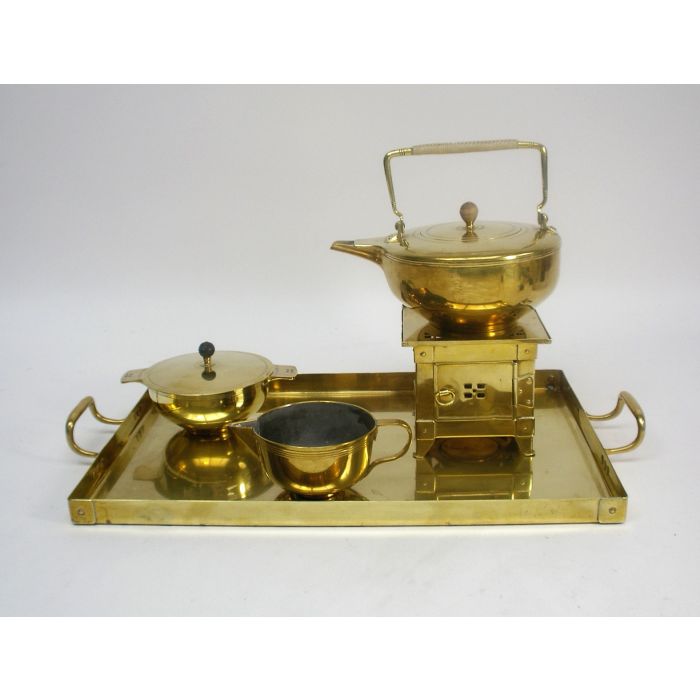
Born in 1876, Eisenloeffel became closely associated with the constructive strand of Dutch Art Nouveau, sometimes referred to within the broader context of Nieuwe Kunst. Rather than disguising how an object was made, his designs often did the opposite: rivets remained visible, handles appeared structurally attached, and decoration was subordinated to form. The Rijksmuseum explicitly describes his work as belonging to this constructive tendency and compares his emphasis on construction with that of architect H.P. Berlage. Rijksmuseum
The result was metalwork that could look startlingly modern even before 1910.
[[product:1]]
Dutch Art Nouveau without the excess
Dutch Art Nouveau developed several different visual languages.
The Kunstmuseum Den Haag distinguishes a more decorative current from a rational or constructive school, centred largely around Amsterdam, in which ornament was used to emphasise the structure of an object rather than conceal it. Kunstmuseum Den Haag

Eisenloeffel belongs firmly to this second tradition.

His kettles, tea services and domestic objects are often built from clear geometric volumes. Instead of covering their surfaces with floral decoration, he allowed material, proportion and construction to become the design.
A rivet was not necessarily something to hide.
A seam could remain legible.
A handle could look attached because it actually was attached.
Construction was not hidden beneath the design. Construction became the design.
Metal as architecture
This approach becomes particularly clear in Eisenloeffel's tea and coffee objects.
A brass teapot in the Rijksmuseum, dated approximately 1900–1910, sits on a low foot and expands outward into a broad body. Its angular handle is partially wrapped in cane, while the spout is visibly attached to the body with five rivets. Rijksmuseum

Those rivets are not accidental visual noise.
They make the object's assembly readable.
This fascination with construction links Eisenloeffel's metalwork to wider ideas circulating in Dutch architecture and design at the time: beauty should arise from function, material and honest construction rather than applied ornament.
That does not make the objects austere.
Small details — profiled bands, contrasting wood, cane wrapping or subtle surface treatment — soften the geometry without obscuring it.
Brass was as important as silver
Eisenloeffel worked across different levels of material value.
His museum-documented work includes objects in brass, copper and silver.
The Kunstmuseum Den Haag holds a red-copper sugar bowl designed by him and made by Amstelhoek for 't Binnenhuis, dating to 1899–1901. Kunstmuseum Den Haag

The Rijksmuseum preserves an extensive brass tea service from around 1900–1910, including teapot, milk jug, tea caddy, sugar bowl and other related pieces. Rijksmuseum
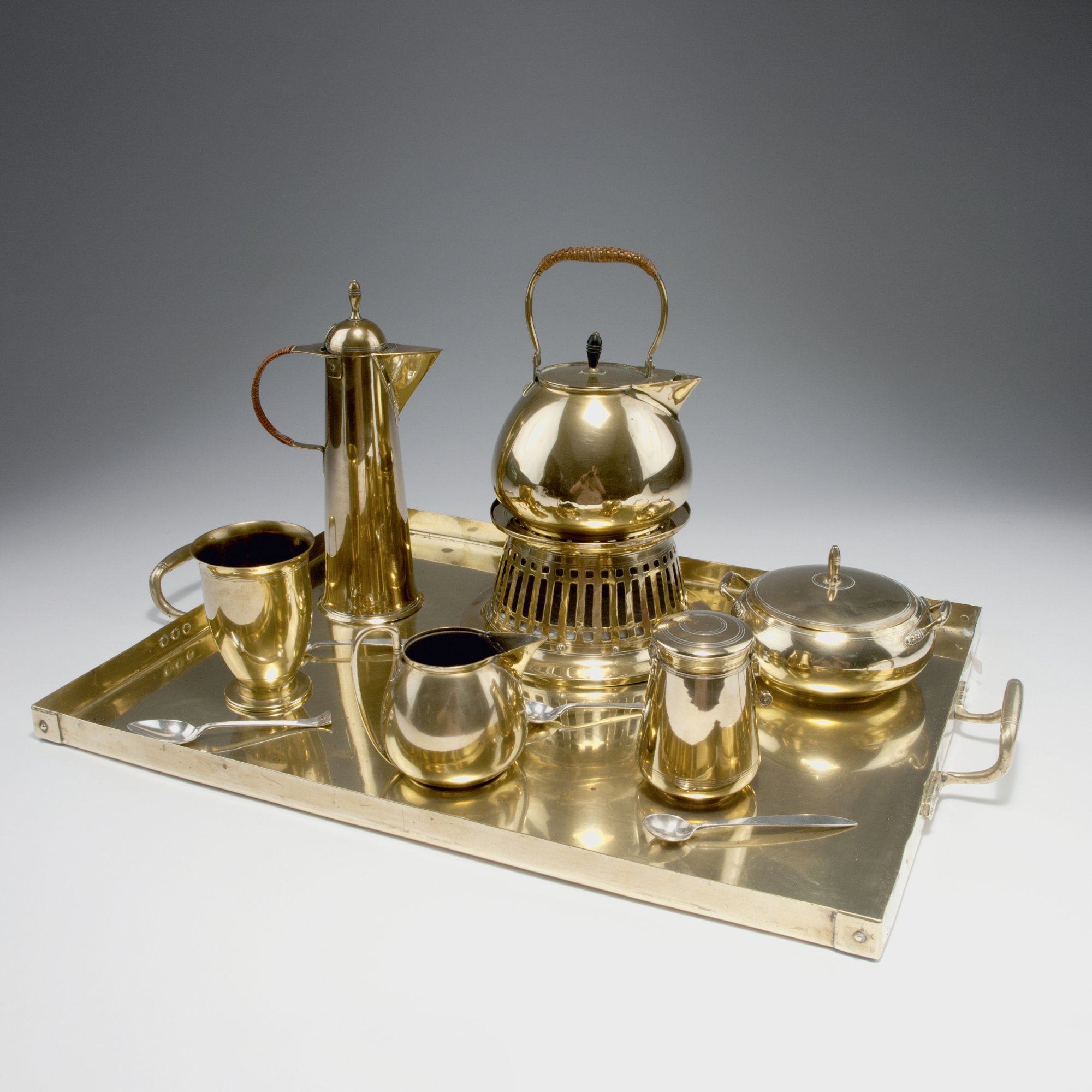
At the same time, Eisenloeffel also designed more luxurious silver work.
A three-piece silver and enamel tea service of 1903, produced by the Amsterdam silversmith Firma Hoeker & Zoon, combines silver with enamel, ebony and cane. Rijksmuseum

This range is important.
Eisenloeffel's significance does not depend on precious metal. The same design principles could appear in relatively straightforward brass objects and sophisticated silver commissions.
Amstelhoek and the idea of modern domestic design
Around the turn of the century, Eisenloeffel was connected with Amstelhoek, an Amsterdam workshop producing ceramics and metalwork.
Surviving museum objects confirm designs by Eisenloeffel executed by Amstelhoek for the influential interiors retailer 't Binnenhuis around 1899–1901. Kunstmuseum Den Haag
This context matters because Dutch reform designers were not simply trying to produce decorative luxury goods.
There was a broader ambition to improve the quality of everyday surroundings.
The object on the table — a kettle, sugar bowl or lamp — could participate in the same modern design philosophy as a building or an interior.
That idea is one reason Eisenloeffel's work feels so architectural.
From Amstelhoek to De Woning
Eisenloeffel later became involved with De Woning, another artists' cooperative concerned with modern interior design.
A Sotheby's catalogue describing one of his brass bouilloires notes that he had been appointed head of Amstelhoek's metal workshop in 1899 and, after leaving the orbit of 't Binnenhuis, became a co-founder of De Woning in 1903. Sothebys.com
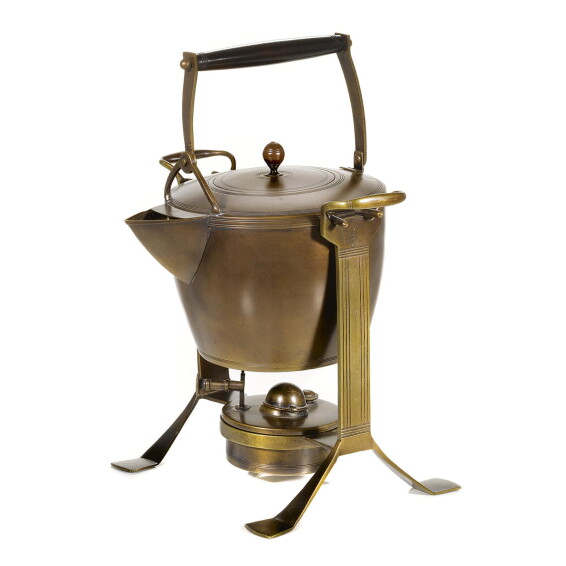
The same source describes him as one of the leading figures of the rationalist movement within Dutch Art Nouveau.
This period coincides with some of the designs for which he is best remembered today: kettles and tea objects with simple profiles, visible rivets and minimal applied decoration.
The Japanese connection
There is another important influence behind these forms.
Sotheby's notes that Eisenloeffel's kettles drew inspiration from Japanese tea and sake vessels and that his designs became popular enough to be widely imitated in the Netherlands and Germany. Sothebys.com
This makes sense visually.
Rather than the vertical, ornate silhouette often associated with nineteenth-century European silverware, many of his kettles sit low and wide.
Their bodies can feel almost compressed.
Handles rise above them in simple arcs or angular forms.
Wood, cane and metal are allowed to contrast naturally.
Japanese influence here was therefore not simply decorative.
It affected proportion, construction and the relationship between materials.
Why the rivets matter
Eisenloeffel's visible rivets are probably his most immediately recognisable design feature.
But they should not be treated as a signature on their own.
Visible construction became part of a broader vocabulary of Dutch and German reform design. Other manufacturers and designers adopted similar ideas, and Eisenloeffel's successful kettle forms themselves inspired later production. Sothebys.com
So:
Visible rivets can suggest a design language. They do not prove an Eisenloeffel attribution.
A secure attribution becomes much stronger when form, construction, dimensions and maker's marks correspond with documented examples.
[[collection:1]]
His maker's mark
Fortunately, documented marked works survive.
A brass milk jug in the Rijksmuseum bears Eisenloeffel's maker's mark: a J and E monogram surrounded by the name JAN EISENLOEFFEL. The museum dates the piece to approximately 1900–1910. Rijksmuseum

This provides a useful reference point when studying pieces encountered outside museum collections.
But once again, marks need context.
Not every work designed by Eisenloeffel was necessarily manufactured personally by him. His silver tea service of 1903, for instance, is clearly catalogued by the Rijksmuseum with Eisenloeffel as designer and Hoeker & Zoon as silversmith. Rijksmuseum
This distinction between designer and manufacturer is essential.
A mark may tell us who made an object.
A design credit may tell us who conceived it.
Sometimes those people are the same.
Sometimes they are not.
The famous tea and kettle forms
Eisenloeffel's tea objects form one of the strongest bodies of surviving evidence for his style.
The Rijksmuseum holds multiple components from a brass tea service dating to approximately 1900–1910, while the Kunstmuseum Den Haag preserves related early work. Rijksmuseum
The recurring language is unmistakable:
low broad bodies, sharply defined rims, restrained decoration, contrasting wooden or cane elements and clearly legible joints.
The museum collections are particularly valuable because they allow individual objects seen on the market to be compared with firmly catalogued examples, rather than relying only on stylistic resemblance.
And that brings us back to attribution.
“In the style of” is not the same as “by”
Eisenloeffel's influence was substantial enough that related objects can be encountered without his mark.
Some may be period works by other Dutch designers.
Some may be German.
Some may be later imitations.
Some may genuinely relate to his workshop or known designs.
The appropriate question is therefore not:
Does this look like Eisenloeffel?
It is:
Can this object be connected to a documented Eisenloeffel design?
Dimensions, silhouette, rivet placement, spout construction, handle treatment, materials and maker's marks can all contribute to that comparison.
Similarity begins the investigation.
Documentation completes it.
A piece from Les Trois Curieuses

A Jan Eisenloeffel tea vessel selected by Les Trois Curieuses shows many of the qualities that make his metalwork so distinctive.
The restrained metal body, contrasting wooden element and visibly constructed details belong to the same vocabulary found in documented museum examples from the opening decade of the twentieth century.
[[product:1]]
Most importantly, comparable forms can be studied directly in the Rijksmuseum collection, where related brass tea vessels and a Waterketel met standaard are catalogued under Eisenloeffel's name and dated to approximately 1900–1910. Rijksmuseum
That comparison is far more useful than simply calling the object “Art Nouveau.”
It places it within a specific Dutch approach to modern design in which structure, material and function became inseparable.
Why Eisenloeffel still looks modern
More than a century later, Eisenloeffel's objects can feel strangely contemporary.
There is very little unnecessary decoration.
The geometry is strong.
Materials are allowed to look like themselves.
And the way the object was assembled remains visible.
This was not minimalism in the twentieth-century sense.
It was an early attempt to create a modern decorative language based on honesty of construction.
That is what separates Eisenloeffel from the more familiar image of Art Nouveau.
No swirling stems are necessary.
No surface needs to disappear beneath ornament.
Sometimes modernity begins with something as simple as a rivet left visible.
The structure is not behind the design. It is the design.


