


Light, form and attribution in Art Deco glass
Among the great names of French Art Deco glass, Marius-Ernest Sabino developed one of the period’s most distinctive relationships with light.
His work is particularly associated with opalescent glass: a material that can appear milky white in one light, softly blue in another, and almost translucent around its thinnest edges. Combined with moulded relief, satin surfaces and sculptural forms, this changing quality gives Sabino glass its unmistakable presence.
But opalescence alone is never enough to identify a piece.
Understanding Sabino means looking beyond colour: at the model, the technique, the surface, the markings and, above all, the documentation surrounding the object.
[[product:1]]
Glass shaped by light
Sabino’s production reached its characteristic maturity during the interwar period, when glass became an important material within the vocabulary of French Art Deco.
Rather than treating glass simply as a transparent substance, Sabino exploited its ability to absorb, diffuse and transform light.
A vase such as La Ronde, preserved in the Musée des Arts Décoratifs in Paris and dated to around 1925–1930, is recorded as press-moulded opalescent crystal and bears the engraved signature “Sabino Paris.” Collections du MAD Paris

The Corning Museum of Glass also holds a Sabino miniature bird from around 1932. Made from bluish opalescent glass, it was pressed and acid-etched and is inscribed “Sabino / Paris / France.” Collection de Verre
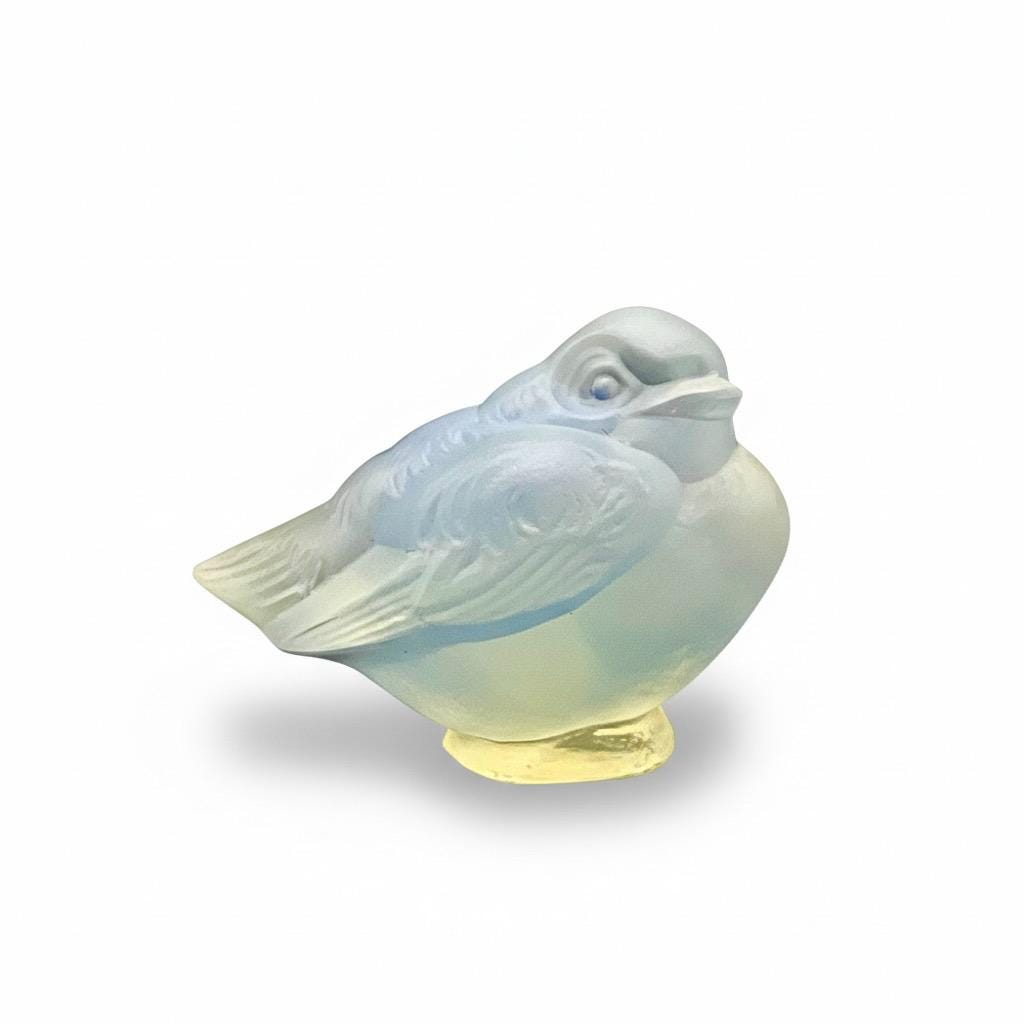
These objects illustrate several recurring characteristics of his work: relief created through moulding, softened surfaces and a material whose appearance changes dramatically according to the direction of the light.
What does “opalescent glass” actually mean?
The word opalescent describes an optical quality rather than a manufacturer.
Opalescent glass contains areas of varying translucency that scatter light, producing an effect reminiscent of an opal. Depending on its composition, thickness and manufacture, it can shift between white, blue, amber or warmer tones when viewed under different lighting conditions.
Different formulas and techniques have been used to create this effect. The Corning Museum of Glass notes several historical methods of producing opalescent glass, demonstrating that it is a category of glass rather than the invention or exclusive material of one glassmaker. Corning Museum of Glass

Opalescent does not mean Sabino
This distinction is particularly important.
An opalescent object is not automatically a Sabino.
Sabino was one of several important makers to use opalescent glass during the first half of the twentieth century. René Lalique, for example, produced documented opalescent works during the same period. The Corning Museum records Lalique’s Domrémy vase, designed in 1926, as translucent opalescent glass, while its Ceylan vase of 1924 is described as heavy translucent opalescent glass with a satin-like surface. Collection de Verre

Other French manufacturers and designers also worked with comparable materials and finishes.
This means that colour, weight, frosting or a blue glow can never constitute an attribution on their own.
A piece should not be described as Sabino simply because it “looks like Sabino.”
A sculptural Art Deco vocabulary
Sabino’s importance also lies in the forms he chose to give this material.
His repertoire included vases, perfume bottles, lighting, animals, figurines and decorative objects. Figures and animals could be highly modelled, while other pieces relied on architectural or geometric relief.
Press-moulding allowed designs to be reproduced, but this should not be confused with an absence of artistic design. The original model determined how light would interact with every raised surface, hollow and edge.
In opalescent glass, relief has a particular importance. Thick areas may appear dense and milky, while thinner areas transmit more light. The object therefore changes visually according to its shape.
This interaction between model, glass and light is one of the most compelling aspects of Sabino’s work.
Signatures - useful, but not the whole story
Documented Sabino pieces can carry several forms of marking.
Museum examples include “Sabino Paris” and “Sabino / Paris / France.” Collections du MAD Paris
/image%2F1010451%2F20201210%2Fob_70073a_autre-signature-baton-sabino2.jpg)

Auction archives also document signed Sabino perfume bottles and other decorative objects from the Art Deco period. Gazette Drouot

A period signature is therefore an important piece of evidence.
But attribution cannot always be reduced to a simple question of whether a signature is present.
Unsigned examples of known models exist, while signatures themselves must always be considered together with the object. Conversely, an object should never be attributed to Sabino solely because its material or style resembles his work.
A serious attribution relies on a combination of evidence:
the known model, dimensions and proportions, manufacturing technique, material and finish, markings when present, and comparison with documented examples.
The stronger the documentation, the stronger the attribution.
[[collection:1]]
Documented models matter
This is why model identification can be particularly valuable when studying Art Deco glass.
When the same design can be traced through museum collections, period documentation, specialist literature or well-catalogued auction records, the object can be considered in a much more precise context.
This approach is especially useful for pieces whose markings are absent, worn or difficult to interpret.
Rather than asking simply “Does this look like Sabino?”, the more meaningful question becomes:
“Can this object be connected to a documented Sabino model?”
That difference is fundamental.
The Eiffel Tower perfume bottle
One of the most unusual designs associated with Sabino transforms one of Paris’s most recognisable monuments into a perfume bottle.
The Eiffel Tower bottle combines several worlds at once: architecture, perfume, decorative glass and the culture of Paris as a modern city.
Instead of merely reproducing the monument as a souvenir, the glass transforms its structure into a compact sculptural object. The relief becomes especially striking in opalescent material, with edges and architectural details responding differently to transmitted light.
Examples of Sabino Eiffel Tower bottles are documented on the art and antiques market, providing useful comparisons for studying the model.
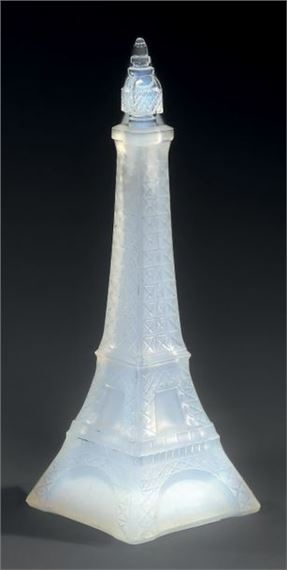
And it gives us a particularly interesting case of attribution.
A piece from Les Trois Curieuses
Our own Eiffel Tower perfume bottle measures approximately 17.2 cm high, with a 7 cm base, and is made from opalescent glass.

The bottle is unsigned and its original stopper is no longer present.
For that reason, we do not base its attribution on a signature.
Instead, the attribution rests on comparison with the documented Eiffel Tower perfume bottle model associated with Sabino, including its distinctive architectural form and proportions.
This is an important distinction.
An unsigned object should not become “Sabino” simply because it is opalescent. In this case, it is the relationship to a documented model, rather than the colour of the glass alone, that makes the attribution meaningful.
[[product:1]]
Looking at Sabino today
Nearly a century after the height of French Art Deco, Sabino’s glass remains remarkably modern.
Part of its appeal comes from its ambiguity. It is manufactured yet sculptural, solid yet luminous, pale in reflected light and dramatically coloured when illuminated from behind.
More importantly, Sabino’s work reminds us why attribution in decorative arts deserves care.
A colour is not a maker.
A technique is not a signature.
A resemblance is not documentation.
The object becomes truly interesting when all of those clues begin to agree.


