


The Future We Were Promised: When Space Age Design Imagined a Better World
How the Space Age transformed ordinary homes into visions of tomorrow — and what its extraordinary optimism tells us about the future we once imagined.
In 1969, humanity walked on the Moon.

Back on Earth, another revolution was taking place. Furniture was becoming sculptural, houses were beginning to resemble spacecraft, and designers were questioning almost everything we thought we knew about domestic life.
The future was supposed to be bright, effortless and endlessly exciting.
Walls would curve. Furniture would move. Machines would take care of everyday chores. New materials promised to make beautiful design accessible to more people.
It was a world of possibilities, shaped by the extraordinary conviction that technology could make life better.
More than half a century later, we are surrounded by technologies those designers could scarcely have imagined. Yet our homes look surprisingly conventional.
So what happened to the future we were promised?
1. Tomorrow Was a Place You Could Visit
In June 1957, Disneyland unveiled one of its most ambitious attractions: the Monsanto House of the Future.
The house offered visitors a glimpse of domestic life in 1986.
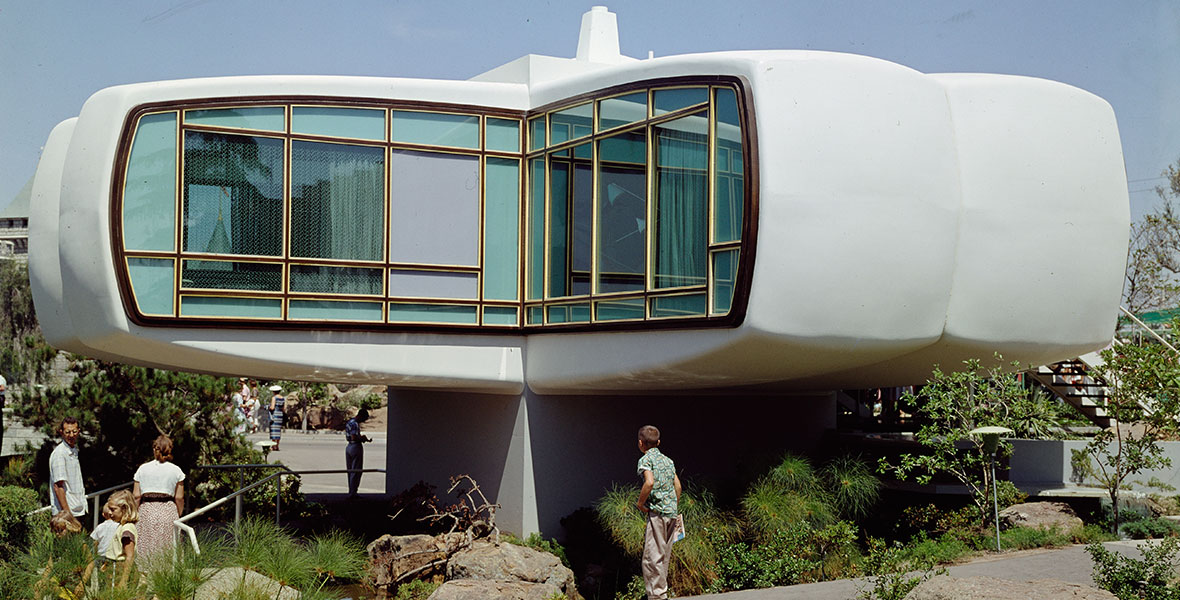 Its architecture was unlike anything found in the average American suburb. Four dramatically cantilevered wings extended from a central structure, while plastics replaced many conventional building materials.
Inside, visitors encountered modern appliances, intercoms and electronic conveniences that were still unusual in ordinary households.
The underlying promise was seductive: technology would transform everyday domestic life into something cleaner, simpler and more enjoyable.
The house was also a spectacular advertisement for the plastics industry. Monsanto wanted to demonstrate that synthetic materials could be sophisticated architectural solutions rather than inexpensive substitutes.
The attraction closed in December 1967. Its vision of the future never became the architectural norm.
Yet some of the conveniences associated with futuristic domestic living eventually entered millions of homes.
The future had arrived — just not in the form its designers had imagined.
Historical reference: Disney D23 — Monsanto House of the Future.
[[product:1]]
2. The Designers Who Wanted to Reinvent Living
For a generation of European designers, the future was not simply about inventing new objects.
It was about questioning the structure of everyday life.
Why should a room have only one purpose? Why should furniture remain in the same position? Why should a house be divided into rigid, conventional spaces?
Italian designer Joe Colombo imagined domestic environments that could adapt to their inhabitants.

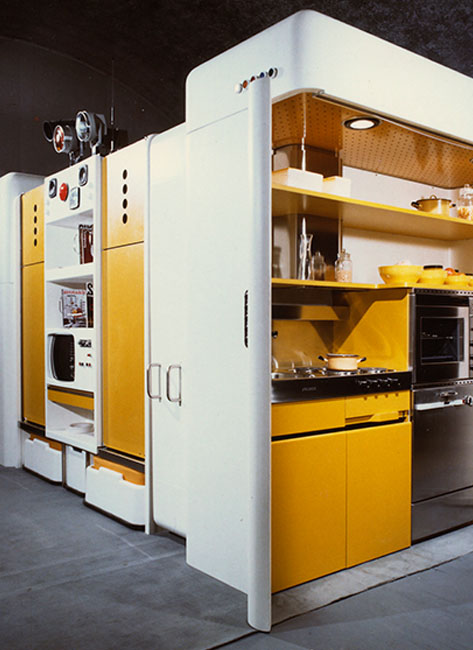
His Total Furnishing Unit, developed in collaboration with Ignazia Favata and exhibited at the Museum of Modern Art in New York in 1972, brought essential household functions together in four independent volumes.
Beds, storage, cooking facilities and bathroom elements became parts of a flexible system rather than permanent architectural arrangements.
The idea was radical: instead of people adapting their lives to fixed interiors, interiors could adapt to people.
Meanwhile, Danish designer Verner Panton explored an entirely different vision of domestic freedom.

For his Visiona II installation in 1970, commissioned by Bayer, Panton created an immersive environment of flowing shapes, saturated colours and soft, sculptural surfaces.
In his famous Fantasy Landscape, the distinctions between floor, walls and furniture seemed to disappear.
It was less a conventional living room than a landscape designed for relaxation, conversation and sensory experience.
[[collection:1]]
Both designers challenged the familiar domestic environment, but in different ways.
Colombo imagined efficiency through flexibility. Panton imagined freedom through experience.
Together, their work suggested that the home of tomorrow might not resemble a home at all.
Historical references: MoMA — Italy: The New Domestic Landscape (1972), MoMA — Original documentation of Joe Colombo's Total Furnishing Unit and Verner Panton Archive — Visiona II (1970).
3. Plastic Was Once a Promise, Not a Problem
Today, plastic is often associated with pollution, disposable products and environmental damage.
In the 1960s, however, its cultural meaning was almost the opposite.
Synthetic materials represented liberation from traditional manufacturing constraints.
Designers could create flowing shapes, continuous surfaces and vivid colours that would have been difficult or prohibitively expensive to produce using conventional materials.
Plastics also carried a democratic promise.

If innovative furniture could be manufactured industrially, perhaps good design no longer needed to remain the privilege of wealthy households.
The possibilities seemed limitless.
Panton's experiments demonstrate this optimism particularly well. His celebrated cantilevered chair, developed over many years and introduced commercially by Vitra in 1967, made striking use of synthetic materials to achieve a continuous sculptural form.
But this optimism contained a contradiction.

The very materials that promised durability, affordability and freedom would later become associated with overconsumption and waste.
The oil crises of the 1970s, growing environmental awareness and changing economic conditions complicated the utopian narrative surrounding synthetic materials.
The dream of limitless industrial progress was beginning to meet the reality of finite resources.
Historical reference: Vitra Design Museum — Verner Panton: Form, Colour, Space.
4. The Future Was Also a Social Revolution
Space Age interiors were not only experiments in technology and aesthetics.
They emerged during a period when traditional social structures were being challenged.
The 1960s brought new conversations about gender, youth culture, leisure, individual freedom and the organization of family life.
Domestic design became one way of expressing these changing ambitions.
Informal seating suggested new ways of gathering. Flexible furniture reflected increasingly mobile lifestyles. Open and multifunctional interiors challenged established boundaries between work, leisure and private life.

Yet there was another contradiction.
Advertisements for futuristic kitchens often promised to liberate women from household chores while continuing to assume that domestic work remained primarily their responsibility.

The technology was revolutionary. The social expectations were not always so progressive.
This tension has been explored by the Museum of Modern Art in its exhibition Counter Space: Design and the Modern Kitchen, which examined how kitchens reflected changing technologies, consumer culture and women's domestic roles.
[[product:4]]
The contradictions make Space Age design especially fascinating today.
Its objects tell us not only how people imagined the future, but also which parts of their present they struggled to leave behind.
Historical references: MoMA — Counter Space: Design and the Modern Kitchen and MoMA — Kitchens of the Future.
5. Why the Space Age Dream Faded
By the mid-1970s, the atmosphere that had inspired much of the movement had begun to change.
Economic uncertainty, the oil crisis, environmental concerns and shifting cultural priorities challenged the belief that continuous technological expansion would inevitably improve society.
Many experimental interiors were expensive to manufacture, difficult to maintain or simply impractical for everyday life.
Others had been conceived primarily as exhibitions and speculative environments rather than commercially viable homes.
The future imagined by the designers of the 1960s did not vanish overnight. It gradually fragmented.
Some ideas became ordinary: modular furniture, integrated storage, synthetic materials and flexible domestic arrangements.
Others remained extraordinary visions, preserved in photographs, museum collections and the occasional surviving architectural experiment.
The installations commissioned for Bayer's Visiona exhibitions remain especially revealing. Conceived as temporary showcases, they allowed designers to explore radical possibilities without all the constraints of ordinary residential construction.

Their influence was cultural and artistic, even when their most spectacular forms never entered mass production.
And perhaps that is what makes them so compelling.
Their unrealized ambitions are still visible.
Further reading: Vitra Design Museum — Visiona: Revisiting the Future and TU Delft — Total Furnishing Unit: Joe Colombo with Ignazia Favata.
[[product:2]]
6. Collecting Fragments of an Imagined Tomorrow
Today, an original Space Age object carries a meaning beyond its immediate function.
An acrylic magazine rack, a futuristic clock or an organically shaped lamp is not simply an expression of vintage taste.
[[product:1]]
It belongs to a moment when designers believed that even the smallest household object could participate in a larger transformation of society.
These pieces capture an optimism that feels increasingly unfamiliar.
They remind us of a time when the future was imagined not only as technologically advanced, but also as colourful, playful and full of possibility.
Perhaps this explains their enduring appeal.
We do not collect Space Age design because the future turned out exactly as predicted.
We collect it because it didn't.
Every surviving object is a small fragment of a tomorrow that someone once believed was possible.
And sometimes, preserving that imagination is just as valuable as preserving the object itself.
Explore our Space Age collection at Les Trois Curieuses — pieces from a time when design dared to imagine a different world.
[[collection:2]]
Sources & Further Reading
Museums and institutional archives
-
Disney D23 — Monsanto House of the Future. Historical overview of the 1957–1967 Disneyland attraction.
-
The Museum of Modern Art (MoMA) — Italy: The New Domestic Landscape, 1972. Exhibition archives documenting experimental Italian domestic design.
-
The Museum of Modern Art (MoMA) — Total Furnishing Unit: Original Exhibition Documentation. Contemporary archival material detailing Joe Colombo and Ignazia Favata's project.
-
Vitra Design Museum — Visiona: Revisiting the Future. Exhibition history of the experimental interiors commissioned by Bayer.
-
Verner Panton Archive — Visiona II, 1970. Official documentation of Panton's celebrated Fantasy Landscape.
-
Vitra Design Museum — Verner Panton: Form, Colour, Space. Historical overview of Panton's materials, furniture and spatial experiments.
-
The Museum of Modern Art (MoMA) — Counter Space: Design and the Modern Kitchen. Examination of domestic technology, modernity and gender roles.
Academic research
-
TU Delft, DASH — Delft Architectural Studies on Housing — Total Furnishing Unit: Joe Colombo with Ignazia Favata. Academic study of Colombo's experimental approach to flexible domestic space.


