


From nineteenth-century Bohemia to the atomic age
Under ordinary light, uranium glass can appear surprisingly innocent.
Pale lemon yellow. Apple green. Amber. Sometimes almost colourless.
Then ultraviolet light hits it — and the glass becomes an intense, almost electric green.
Today, that transformation is the feature most closely associated with uranium glass. But the history of the material is considerably stranger than its glow.
Uranium was being deliberately added to decorative glass long before radioactivity had even been discovered.
What began in nineteenth-century Central Europe as an experiment in colour survived industrialisation, changing fashions, two world wars and eventually the atomic age itself.
[[product:1]]
Before uranium was “radioactive”
The story begins in 1789, when German chemist Martin Heinrich Klaproth identified uranium while studying the mineral pitchblende.
But the scientific understanding of the element was still extremely limited.
The earliest known reference to uranium being used in glass dates to around 1817, according to the Corning Museum of Glass. Corning Museum of Glass
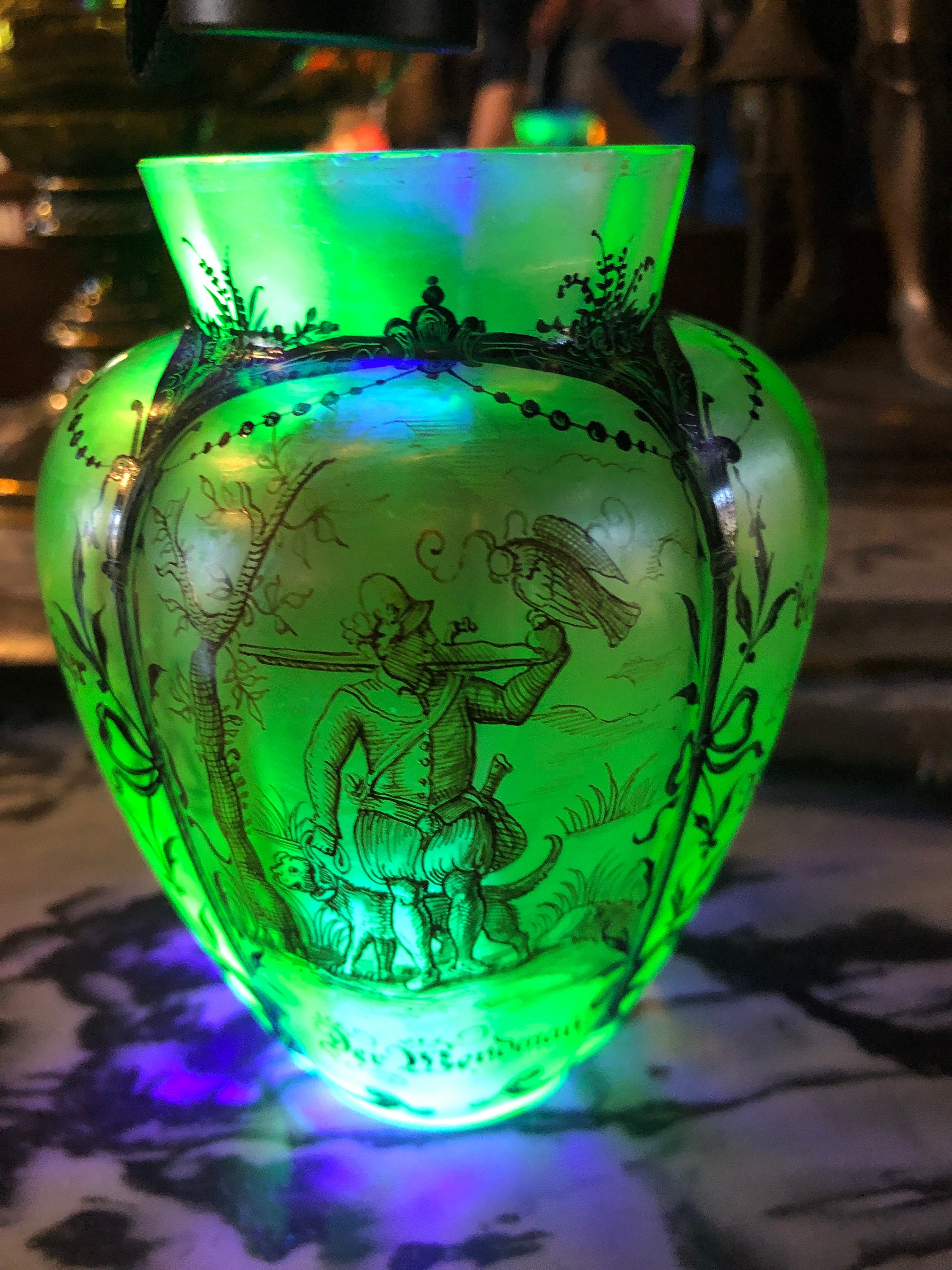
At this point, no one knew uranium was radioactive.
That discovery would not come until 1896, when Henri Becquerel demonstrated that uranium compounds emitted radiation spontaneously. CEA/Recherche et innovation
In other words, glassmakers had been deliberately incorporating uranium compounds into decorative objects for decades before science understood one of the element's most remarkable properties.
They were interested in something much simpler:
colour.
Josef Riedel and the colours of Bohemia
The decisive development came in Bohemia during the 1830s.
Glassmaker Josef Riedel developed two particularly vivid uranium-coloured glasses.
The yellow version was called Annagelb.
The green version was called Annagrün.
Both were named after his wife, Anna. The Corning Museum of Glass dates their production from 1834, while the V&A likewise credits Riedel with developing uranium glass in the 1830s. Corning Museum of Glass
.jpg?mode=max)
These were not novelty objects designed to glow under black light — ultraviolet lamps were hardly sitting in Victorian living rooms.
Their attraction was visible in ordinary daylight.
Uranium compounds could produce unusually luminous yellows and greens, perfectly suited to the nineteenth-century appetite for intense colour in decorative glass.
The Museum of Applied Arts in Budapest describes uranium glass as particularly popular during the Biedermeier period, when colourful decorative and cabinet pieces were highly fashionable. Collections IMM

The glow was almost beside the point
This is one of the most interesting misconceptions surrounding uranium glass.
Its famous fluorescence was not necessarily the reason nineteenth-century buyers wanted it.
The material already had a remarkable appearance in daylight.
Placed near a window, a yellow-green uranium glass object could seem unusually vivid because daylight itself contains ultraviolet wavelengths capable of producing some fluorescence.
But its real appeal was the colour the uranium created within the glass.
The fluorescent spectacle collectors deliberately produce today with UV torches is, in a sense, a modern way of experiencing an old material.

From luxury glass to everyday objects
Early uranium glass could be highly elaborate.
Bohemian examples were cut, polished, engraved and enamelled like other luxury glass of the period. Museum collections preserve substantial decorative pieces dating from the 1830s and 1840s, including examples of the yellow Annagelb type. Bayerisches Nationalmuseum

But uranium glass did not remain confined to expensive display pieces.
By the middle of the nineteenth century it was appearing in a broader range of objects: commemorative glasses, spa drinking vessels, lampshades, pharmacy bottles and household glassware. Collections IMM

As pressed-glass manufacturing expanded later in the century, uranium colourants could also be used in increasingly industrialised production.
The Corning Museum of Glass, for example, holds an English pressed uranium-glass sugar bowl dating to approximately 1840–1860. Collection de Verre

The material had moved from chemical curiosity to commercial glass colour.
[[collection:1]]
And then science discovered what uranium actually did
This is where the story takes its strange turn.
In 1896, more than half a century after Riedel's Annagelb and Annagrün appeared, Henri Becquerel discovered natural radioactivity while experimenting with uranium salts. Lawrence Berkeley National Laboratory
Suddenly, the element glassmakers had been using for colour had an entirely new scientific identity.
Yet uranium glass did not immediately disappear.

It continued to be produced into the twentieth century and appeared not only in decorative glass but in jewellery, buttons, ceramics, enamels and domestic tableware. The McCord Stewart Museum notes its widespread use until the 1940s. Musée McCord Stewart
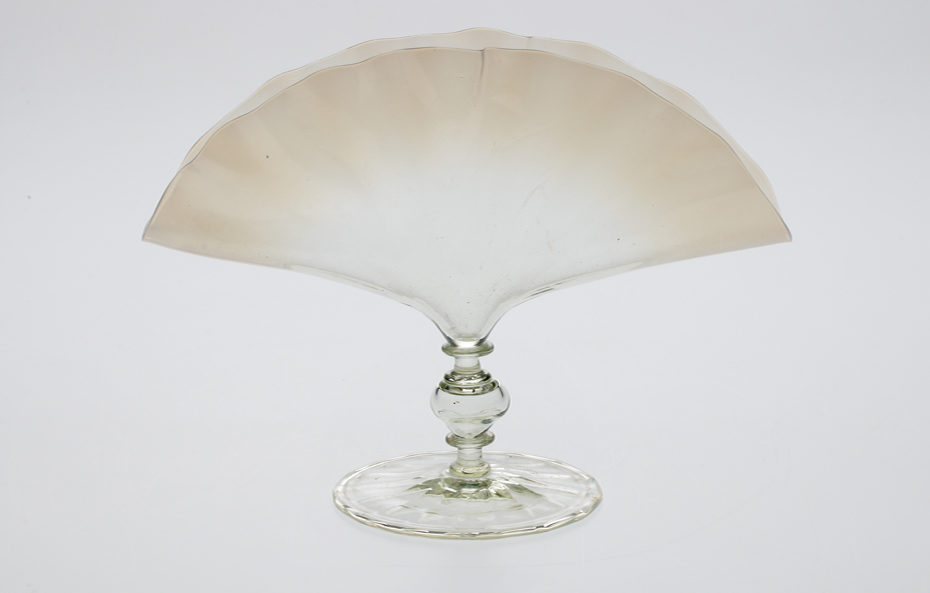
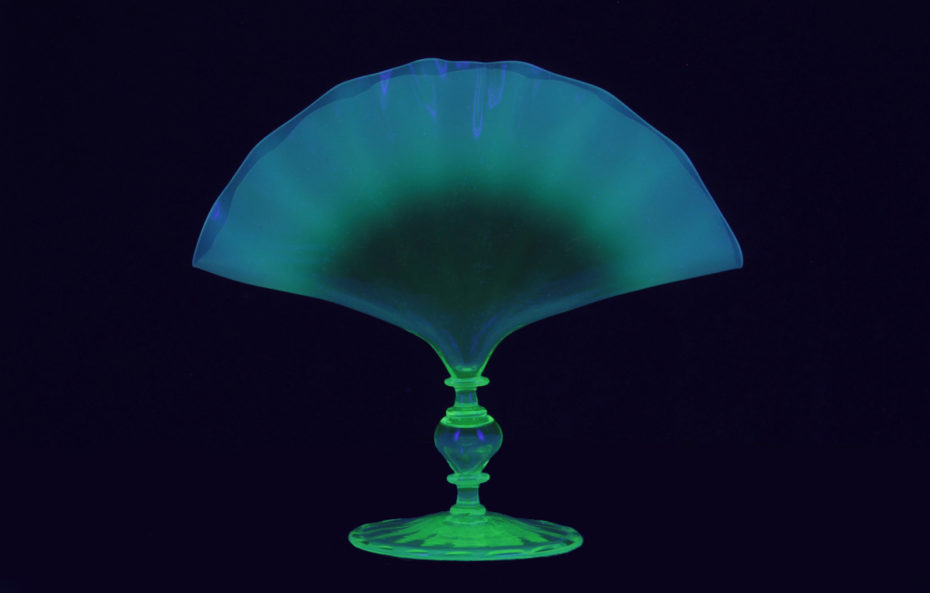
For several decades, then, uranium existed simultaneously as:
a glass colourant,
a scientific curiosity,
and eventually a radioactive element with enormous strategic significance.
Few decorative materials have undergone such a dramatic change in meaning.
The 1920s and 1930s: uranium glass at home
By the interwar period, uranium glass could be thoroughly domestic.
Bowls, dishes, serving pieces, drinking glasses and decorative tableware were produced in yellow and green uranium-containing glass.
The Museum of Radiation and Radioactivity preserves examples of 1930s uranium and Vaseline glass dinnerware, showing how ordinary such objects could once be. Oak Ridge Associated Universities
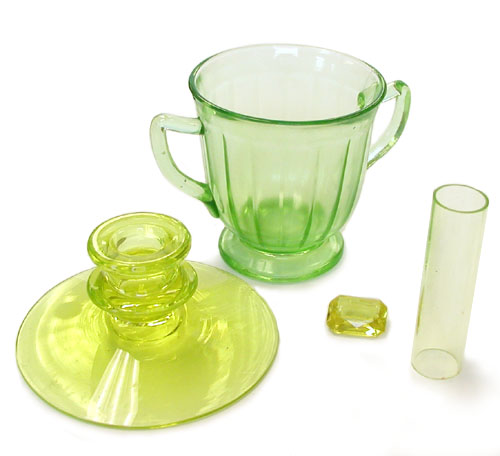
This is important because the modern image of uranium glass as an eccentric collector's object can make us forget what it originally was.
For many owners, it was simply glassware.
A glass, bowl or decanter could contain uranium without being treated as some bizarre scientific artefact.
Uranium glass and the Second World War
That changed dramatically during the twentieth century.
With the development of nuclear research and weapons programmes, uranium ceased to be merely an industrial mineral or colourant.
It became a strategically controlled material.
The Museum of Radiation and Radioactivity notes a roughly fifteen-year interruption in uranium-glass production beginning around the Second World War. Oak Ridge Associated Universities
Production did later resume in some contexts, but the world surrounding uranium had fundamentally changed.
Before the war, the word could evoke colour.
After Hiroshima, Nagasaki and the emergence of the nuclear age, it inevitably carried very different associations.
That cultural shift helps explain why uranium glass now seems much stranger than it would have appeared to its original owners.
Why does uranium glass glow?
The bright green reaction under ultraviolet light is caused by fluorescence.
Uranium compounds embedded within the glass absorb energy from UV light and re-emit part of that energy as visible green light.
Importantly, the visible glow is not the radioactivity itself.
It is an optical phenomenon triggered by ultraviolet radiation. The uranium remains radioactive whether or not a UV lamp is shining on it. ScienceDirect
The Corning Museum of Glass notes that uranium glass typically fluoresces a vivid yellow-green under UV examination. Musée du verre

That distinction is worth remembering:
The uranium makes the glass radioactive. UV light makes its fluorescence visible.
Those are related to the same element, but they are not the same phenomenon.
[[collection:2]]
Is it actually dangerous?
The word uranium understandably sounds alarming.
Historical uranium glass does contain radioactive material and can produce readings above normal background levels with sufficiently sensitive equipment.
However, museum testing generally finds the levels emitted by ordinary decorative uranium glass to be low.
The McCord Stewart Museum tested examples from its own collection with radiation specialists from McGill University and reported extremely low emissions from those objects. The Museum of Applied Arts similarly notes the low uranium content of historical examples in its collection. Musée McCord Stewart
That does not mean every uranium-containing object in existence has identical composition or activity, so it is better not to turn “uranium glass is safe” into a universal rule.
But the fluorescent antique glass found in collections is very different from handling concentrated uranium compounds.
Uranium glass is not necessarily green
Another modern misconception comes from UV photographs.
Because uranium glass fluoresces green, it is easy to assume the glass itself must also be green.
It does not.
Historically, uranium was used to produce yellow and green shades, and its appearance could vary depending on the glass composition and other colourants. Corning Museum of Glass
Opaque and semi-opaque varieties also exist.
So colour in daylight can suggest uranium.
It cannot prove it.
Uranium glass and Vaseline glass are not exactly the same thing
The vocabulary becomes messy very quickly.
Today, uranium glass is the broadest useful term: glass containing uranium used as a colourant.
Vaseline glass, by contrast, traditionally refers more specifically to transparent yellow or yellow-green uranium glass whose colour resembles the petroleum jelly once sold under the Vaseline name.

The Museum of Radiation and Radioactivity points out that Vaseline glass is a comparatively recent collector's term and that uranium glass also includes opaque types that would not normally fit that description. Oak Ridge Associated Universities
So:
All Vaseline glass, in the strict collector sense, is uranium glass. Not all uranium glass is Vaseline glass.
And Depression glass is something else again.

That term describes glassware associated with a period and production context, not a chemical composition. Some Depression-era glass contains uranium; plenty does not.
A green UV glow is powerful evidence — but context still matters
UV examination is one of the most accessible ways of identifying uranium glass.
A strong, characteristic green fluorescence through the body of the glass is a very useful clue. Museums use UV examination for exactly this reason. Oak Ridge Associated Universities
But fluorescence exists in other historical glasses too.
Different ingredients can react under ultraviolet wavelengths, and conservation specialists caution that fluorescence alone does not identify every glass composition with certainty. Musée du verre
For serious attribution, the UV response belongs alongside the object's colour, manufacture, form, age and — where necessary — instrumental testing.
Once again:
one characteristic should not be asked to tell the whole story.
A piece from Les Trois Curieuses
Our uranium glass set brings together several of the qualities that made this material so compelling.
Seen in ordinary light, the decanter, glasses and tray belong to the elegant language of early twentieth-century table glass.
Under ultraviolet light, the same objects become something entirely different.
The apparently decorative glass reveals the presence of a material whose history connects Bohemian glassmaking, nineteenth-century chemistry and the eventual atomic age.
That transformation is spectacular.
But the glow is only the end of the story.
The more remarkable fact is that objects like these belong to a period when uranium could still be treated simply as another ingredient in the glassmaker's palette.
[[product:1]]
From fashionable colour to atomic material
Few materials reveal changing history as dramatically as uranium glass.
In the 1830s, Josef Riedel used uranium to create brilliant new colours and named them after his wife.
By the end of the nineteenth century, uranium-containing glass had become part of domestic and decorative production across Europe and beyond.
Then science discovered radioactivity.
The twentieth century transformed uranium into one of the most politically and scientifically significant elements on Earth.
And suddenly these bowls, glasses and decanters became relics of a world in which uranium meant something completely different.
That may be the most fascinating thing about uranium glass.
Not that it glows.
But that the object stayed the same while our understanding of the material changed completely.
Uranium glass was invented as a colour. History turned it into something else.


