


When German metalwork met Mettlach ceramics at the beginning of the twentieth century
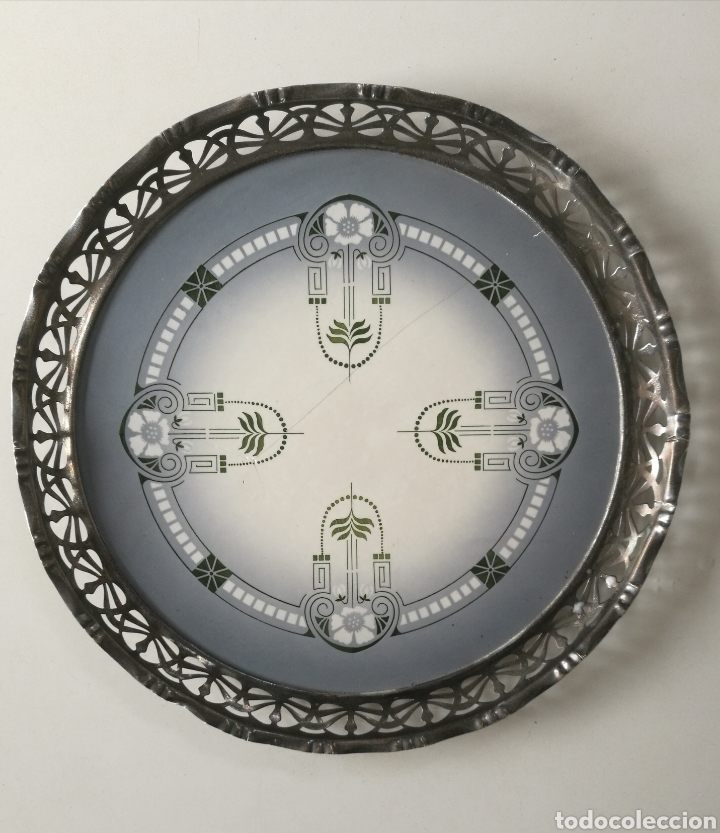
At first glance, a Jugendstil serving tray can seem relatively simple: a decorated ceramic surface held within an elaborate metal frame.
But some of these objects tell a much more interesting story.
At the beginning of the twentieth century, the Nuremberg firm associated with Max Dannhorn produced metal-framed trays and tableware combining industrial metalwork with ceramic inserts. Historical references indicate that many of these ceramic centres were supplied by Villeroy & Boch in Mettlach.
The result was a distinctly German expression of Art Nouveau — or Jugendstil — in which geometry, floral decoration, metal and ceramics became part of a single object.

It also created an attribution problem that still exists today.
A ceramic insert may be associated with Villeroy & Boch, while the metal mount belongs to the production of Max Dannhorn. Some pieces are marked. Others are not. Numbers may appear without a manufacturer's name.
Understanding these trays therefore requires looking at the object as a whole.
[[product:1]]
Max Dannhorn: more than metal trays
The Max Dannhorn firm was established in Nuremberg in 1872.
Its production was broader than the serving trays for which collectors may encounter the name today. Historical sources record the manufacture of metal goods, optical toys and particularly Laterna Magica — magic lanterns — alongside other objects.
By 1896, the business had been incorporated as a joint-stock company and employed around 300 workers. Historical corporate records later specifically mention the production of Jugendstil serving trays and metal-mounted ceramic dishes.
This industrial background is important.
These trays were not simply pieces of pottery with handles added later. They belonged to a manufacturing system in which metalwork was an integral part of the design.
Frames could be made from polished brass or silver-plated metal, with pierced borders, handles and small feet transforming a ceramic plate into a complete serving object.
The Villeroy & Boch connection
This is where the story becomes particularly interesting.
A specialist reference on German porcelain and ceramic manufacturers records that many Max Dannhorn trays contained cream-glazed stoneware inserts produced for the company by Villeroy & Boch at Mettlach. Porcelain Marks and More

Historical company material independently confirms that Max Dannhorn later produced Jugendstil trays and metal-mounted stoneware dishes whose ceramic elements were obtained from Villeroy & Boch. fhw-online.de
So when we look at one of these objects, there may effectively be two manufacturing histories in the same piece:
the ceramic body and decoration from Villeroy & Boch, and the metal mounting and final assembled object from Max Dannhorn.
This explains why descriptions such as simply “Villeroy & Boch tray” or “Max Dannhorn tray” can sometimes be incomplete.
Both names may be relevant — but for different parts of the object.
Mettlach and industrial ceramics
Villeroy & Boch's connection to Mettlach stretches back much further.
Jean-François Boch acquired the former Benedictine abbey at Mettlach in 1809 and transformed it into a highly mechanised ceramics factory. By the nineteenth century, the company had become a major force in industrial ceramic production. villeroyboch-group.com
Mettlach became particularly famous for technically accomplished stoneware and decorative ceramics.

This industrial expertise made Villeroy & Boch a natural supplier for manufacturers producing objects that combined ceramics with other materials.
The Max Dannhorn trays sit precisely within this context: they are not simply tableware, but examples of industrial collaboration within the decorative arts.
What makes these trays Jugendstil?
Jugendstil was the German-speaking world's expression of the broader European Art Nouveau movement around the turn of the twentieth century.
But not every Jugendstil object is covered in flowing flowers.
The movement could move between organic decoration and surprisingly severe geometry.
On Max Dannhorn-associated trays, we encounter both tendencies.
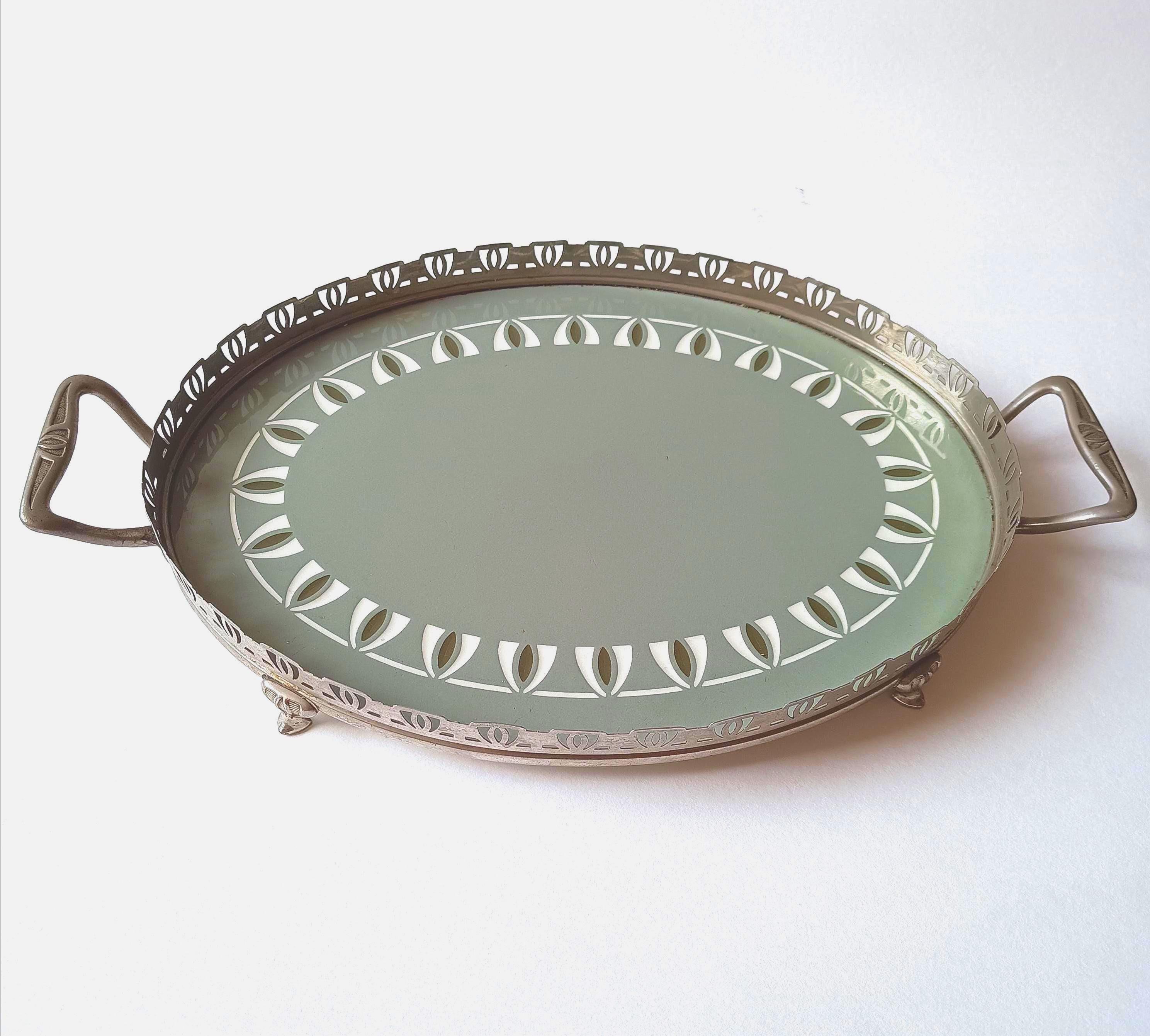
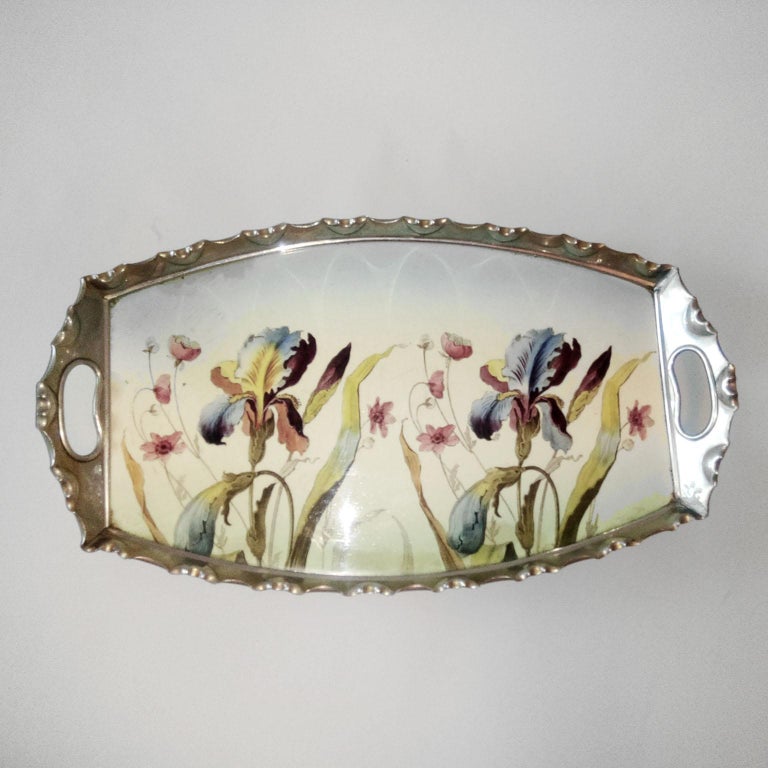 Some ceramic inserts feature irises, water lilies or stylised branches — motifs deeply connected to Art Nouveau's fascination with nature. Others use dots, borders, repetitive lines and strongly structured geometric compositions.
The metal frame often participates in the design.
Pierced edges, elongated handles and controlled curves can echo or contrast with the ceramic decoration underneath. In the most successful examples, neither material feels secondary.
The ceramic and metal were conceived to work together.
The difficulty of marks
This is also where attribution becomes more complicated.
The Max Dannhorn trademark was apparently not consistently applied to the firm's products. Specialist records note that marks are comparatively uncommon, particularly on these combined objects. Porcelain Marks and More
Marked examples do exist.
Auction archives document trays bearing the Max Dannhorn mark, including early twentieth-century stoneware examples with metal mounts.
But the absence of a mark cannot automatically exclude an association with the firm.
And the reverse is equally important:
an unmarked metal-mounted ceramic tray should not automatically be called Max Dannhorn simply because it resembles one.
As with any attribution, documented comparison matters.
[[collection:1]]
A number is not a maker's mark
This distinction deserves particular attention because numbers frequently appear on antique ceramics.
A painted, printed or impressed number may refer to a decoration, pattern, model, shape or production reference.
It is not automatically a manufacturer's trademark.
In other words:
A model or decoration number can help identify a pattern. It does not, by itself, identify the maker.
This becomes particularly important when examining unmarked pieces.
A number can become meaningful when the same number, decoration and form appear on securely documented examples. But it should never be transformed into a manufacturer's mark simply because an attribution seems plausible.
The evidence still has to come from somewhere else.
Attribution through documented examples
Unsigned decorative arts often require a different approach from objects carrying an obvious factory mark.
Instead of relying on one clue, attribution can depend on a combination of evidence:
the shape of the ceramic insert, its decoration, dimensions, construction of the metal frame, surviving manufacturer marks on comparable pieces, pattern references and securely documented examples in collections or auction archives.
This is especially relevant to Max Dannhorn's production because of the composite nature of the objects.
A ceramic centre may correspond closely to documented Villeroy & Boch production while the surrounding mount corresponds to known Dannhorn construction.
Neither observation should be stretched further than the evidence allows.
Sometimes the most accurate description is therefore “attributed to”, “associated with” or “consistent with documented examples” rather than a categorical manufacturer's name.
That distinction may look small in a catalogue description.
In attribution, it is fundamental.
Villeroy & Boch does not automatically mean Max Dannhorn
There is another shortcut worth avoiding.
Villeroy & Boch was an enormous ceramic manufacturer producing an extraordinary variety of objects.
The fact that a ceramic insert can be identified as Villeroy & Boch does not automatically establish that the completed tray was assembled by Max Dannhorn.
Likewise, a Max Dannhorn metal frame does not mean that every possible ceramic insert must necessarily have been made by Villeroy & Boch.
The documented commercial relationship makes the combination important — but attribution still belongs to the individual object.
This is what makes these trays particularly fascinating.
They require us to distinguish between manufacturer, supplier and assembler, rather than searching for a single famous name to explain the whole object.
A piece from Les Trois Curieuses
One of the Jugendstil trays selected by Les Trois Curieuses brings these questions together particularly well.
Its ceramic surface is framed in metal in the manner associated with early twentieth-century German serving pieces, while its decoration belongs to the graphic vocabulary found in period Villeroy & Boch production.
Rather than treating every visible number or decorative element as a signature, we prefer to distinguish between what is physically marked on the object and what can be established through comparison with documented examples.
That distinction is essential to the way we approach antique decorative arts.
[Discover our Villeroy & Boch Jugendstil Serving Tray →](/products/rare-antique-villeroy-boch-serving-tray-max-dannhorn-style-metal-mount-blue-floral-ceramic-insert-jugendstil-art-nouveau)
One object, several histories
These trays are interesting precisely because they resist the desire to attach a single name to everything.

They bring together two different forms of industrial expertise: German metal manufacturing in Nuremberg and ceramic production at Mettlach.
[[product:1]]
They also remind us that decorative arts were often collaborative long before the modern idea of the named designer became dominant.
A Villeroy & Boch ceramic insert may be part of a Max Dannhorn object.
A Max Dannhorn-style metal mount does not prove the origin of the ceramic.
And a pattern number is not a manufacturer's signature.
Understanding the object means keeping those distinctions intact.
Because attribution is not about finding the most impressive name.
It is about describing the evidence as precisely as possible.


